
How to Read the Smithsonian Volcano Database in Python
On this page
Problem statement
The Smithsonian Institution's Global Volcanism Program keeps the reference list of the world's volcanoes, Volcanoes of the World: every volcano thought to have erupted in the last 11,700 years, the Holocene, with its location, type and tectonic setting, and a second table of each of their known eruptions with dates, explosivity and how each was dated. Newsrooms, hazard agencies and researchers count "active volcanoes" from it. Both tables can be read straight into GeoPandas from the program's WFS service. They join on a six-digit volcano number, and the eruption dates use codes of their own. This page reads both tables and shows what is in them.
Quick answer
Ask the WFS service for GeoJSON and read it with GeoPandas; the setup below reads a copy saved on 19 October 2026:
print(vol[["Volcano_Number", "Volcano_Name", "Country", "Primary_Volcano_Type", "Elevation", "Last_Eruption_Year"]].head(3).to_string(index=False))
print(eru[["Volcano_Name", "Eruption_Number", "Activity_Type", "ExplosivityIndexMax", "StartDateYear", "EndDateYear"]].head(3).to_string(index=False))
Volcano_Number Volcano_Name Country Primary_Volcano_Type Elevation Last_Eruption_Year
210010 West Eifel Volcanic Field Germany Volcanic field 600.0 -8300.0
210020 Chaine des Puys France Lava dome(s) 1464.0 -4040.0
210030 Olot Volcanic Field Spain Volcanic field 893.0 NaN
Volcano_Name Eruption_Number Activity_Type ExplosivityIndexMax StartDateYear EndDateYear
Vulsini 10014 Uncertain Eruption NaN -104 NaN
Colli Albani 10015 Uncertain Eruption NaN -600 NaN
Campi Flegrei 10018 Confirmed Eruption 4.0 -8480 NaN
The volcano table has one row per volcano with its six-digit Volcano_Number, and the eruption table one row per eruption with the same number. The first volcano is Germany's West Eifel field, last active in 8300 BCE, written -8300; Olot in Spain has no known eruption at all. The first eruptions are Italian and prehistoric: two uncertain ones and a confirmed VEI 4 at Campi Flegrei in 8480 BCE.
Two tables and a key
1. The volcano table
print(f"{len(vol):,} volcanoes, {vol.Volcano_Number.nunique():,} numbers, {vol.Country.nunique()} country values, {vol.Region.nunique()} regions")
print(vol.columns.drop(["geometry", "id"]).tolist())
1,214 volcanoes, 1,214 numbers, 88 country values, 19 regions
['Volcano_Number', 'Volcano_Name', 'Volcanic_Landform', 'Primary_Volcano_Type', 'Last_Eruption_Year', 'Country', 'Region', 'Subregion', 'Geological_Summary', 'Latitude', 'Longitude', 'Elevation', 'Tectonic_Setting', 'Geologic_Epoch', 'Evidence_Category', 'Primary_Photo_Link', 'Primary_Photo_Caption', 'Primary_Photo_Credit', 'Major_Rock_Type']
There are 1,214 volcanoes, each with a unique number, in 88 country values and 19 regions. Besides the position and elevation, the table has the volcano's landform, type, tectonic setting, dominant rock type, the category of evidence for Holocene activity, and a paragraph of geological summary. The country count includes shared values such as "Chile-Argentina", which the country page splits.
2. The eruption table
print(eru.Activity_Type.value_counts().to_string())
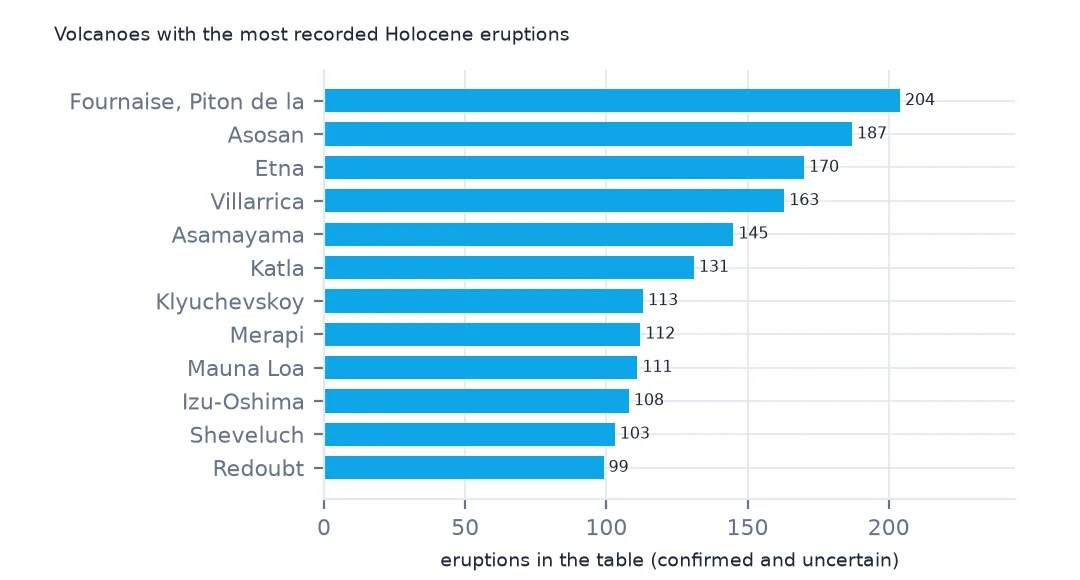
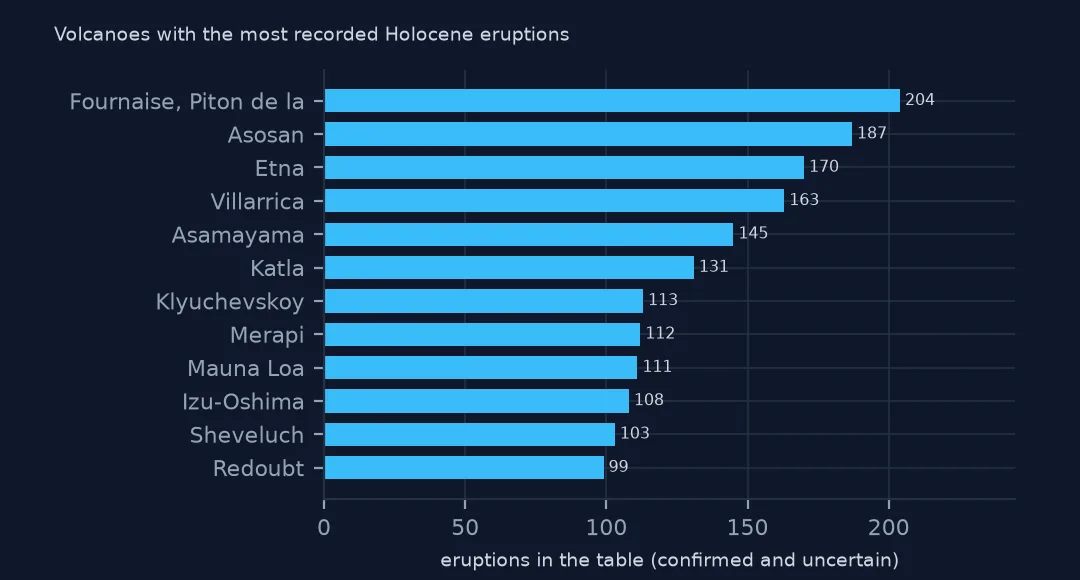
print(f"eruptions per volcano: median {eru.groupby('Volcano_Number').size().median():.0f}, max {eru.groupby('Volcano_Number').size().max()} ({eru.Volcano_Name.value_counts().index[0]})")
Activity_Type
Confirmed Eruption 9916
Uncertain Eruption 1173
eruptions per volcano: median 4, max 204 (Fournaise, Piton de la)
Of 11,089 eruptions, 9,916 are confirmed and 1,173 uncertain. The median volcano with eruptions has 4, and Piton de la Fournaise on Réunion has 204. Names are stored surname-first, "Fournaise, Piton de la", the way the program's index sorts them, so search with str.contains, not equality.
3. The join
orphans = eru[~eru.Volcano_Number.isin(vol.Volcano_Number)]
pleist = gpd.read_file(Z.open("Smithsonian_VOTW_Pleistocene_Volcanoes.json"))
print(f"eruptions whose volcano is not in the Holocene list: {len(orphans)}; of those, in the Pleistocene list: {orphans.Volcano_Number.isin(pleist.Volcano_Number).sum()}")
print(orphans.Volcano_Name.value_counts().head(3).to_string())
eruptions whose volcano is not in the Holocene list: 46; of those, in the Pleistocene list: 46
Volcano_Name
San Pedro-San Pablo 10
Nevsehir-Acigol Volcanic Complex 5
Itasy Volcanic Field 3
46 eruptions belong to volcanoes that are not on the Holocene list. All of them are on the Pleistocene list, which the program keeps for volcanoes without confirmed Holocene activity. An inner join on the Holocene table drops them, so if you count eruptions, count them from the eruption table.
When each volcano last erupted
The data used on this page
The Smithsonian Institution Global Volcanism Program's Volcanoes of the World database (version 5.3 is cited as doi:10.5479/si.GVP.VOTW5-2025.5.3): its Holocene volcano and eruption tables, read from the program's WFS service on 19 October 2026 and saved on this site, because the database is edited as eruptions are reported.
from pathlib import Path
import zipfile

import geopandas as gpd
import numpy as np
import pandas as pd
import requests

Path("data").mkdir(exist_ok=True)
# Smithsonian Global Volcanism Program, Volcanoes of the World: Holocene volcanoes, Holocene eruptions and Pleistocene
# volcanoes as GeoJSON from its WFS service, with Natural Earth's populated places and 1:110m countries.
# Saved 19 October 2026, because the database is edited as eruptions are reported.
# Live: https://webservices.volcano.si.edu/geoserver/GVP-VOTW/ows?service=WFS&version=2.0.0&request=GetFeature
#       &outputFormat=json&typeName=GVP-VOTW:Smithsonian_VOTW_Holocene_Volcanoes (and ..._Holocene_Eruptions)
ARCHIVE = "gvp-votw-2026-10-19.zip"
if not Path(f"data/{ARCHIVE}").exists():
    Path(f"data/{ARCHIVE}").write_bytes(requests.get(f"https://data.spatialworkflow.io/{ARCHIVE}", timeout=600).content)
Z = zipfile.ZipFile(f"data/{ARCHIVE}")
vol = gpd.read_file(Z.open("Smithsonian_VOTW_Holocene_Volcanoes.json"))
eru = gpd.read_file(Z.open("Smithsonian_VOTW_Holocene_Eruptions.json"))
print(f"Volcanoes of the World: {len(vol):,} Holocene volcanoes, {len(eru):,} eruptions")
Volcanoes of the World: 1,214 Holocene volcanoes, 11,089 eruptions
Example 1: last eruption year
conf = eru[eru.Activity_Type == "Confirmed Eruption"].groupby("Volcano_Number")
check = vol.set_index("Volcano_Number").Last_Eruption_Year.to_frame().join(conf.StartDateYear.max().rename("start")).join(conf.EndDateYear.max().rename("end"))
print(f"with a year: {check.Last_Eruption_Year.notna().sum()}; equal to the latest start: {(check.Last_Eruption_Year == check.start).sum()}; "
      f"to the latest start or end: {((check.Last_Eruption_Year == check.start) | (check.Last_Eruption_Year == check.end)).sum()}")
bins = [-1e6, 0, 1499, 1899, 1999, 2100]
labels = ["before 1 CE", "1-1499", "1500-1899", "1900-1999", "2000 on"]
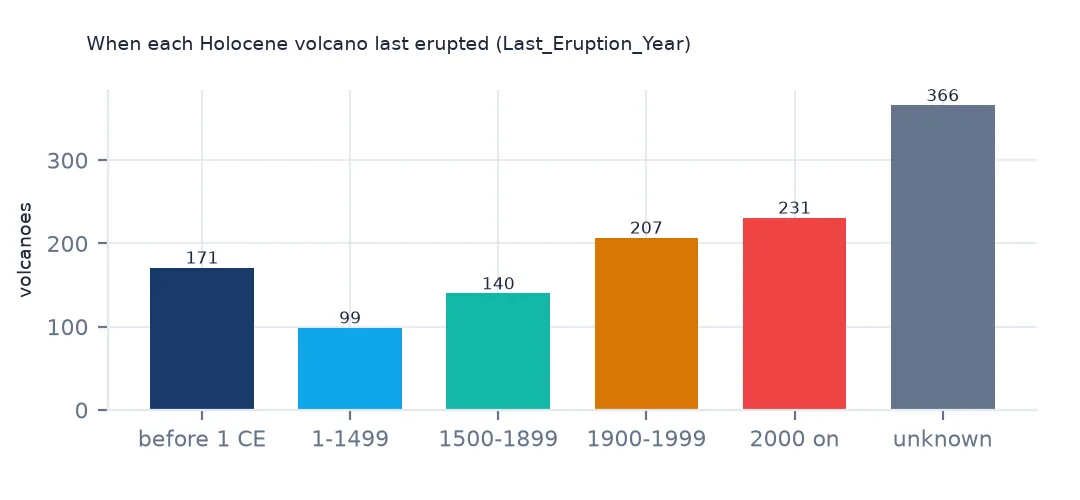
print(pd.cut(vol.Last_Eruption_Year, bins, labels=labels).value_counts(sort=False).to_string(), f"\nno known eruption: {vol.Last_Eruption_Year.isna().sum()}")
with a year: 848; equal to the latest start: 703; to the latest start or end: 848
Last_Eruption_Year
before 1 CE 171
1-1499 99
1500-1899 140
1900-1999 207
2000 on 231
no known eruption: 366
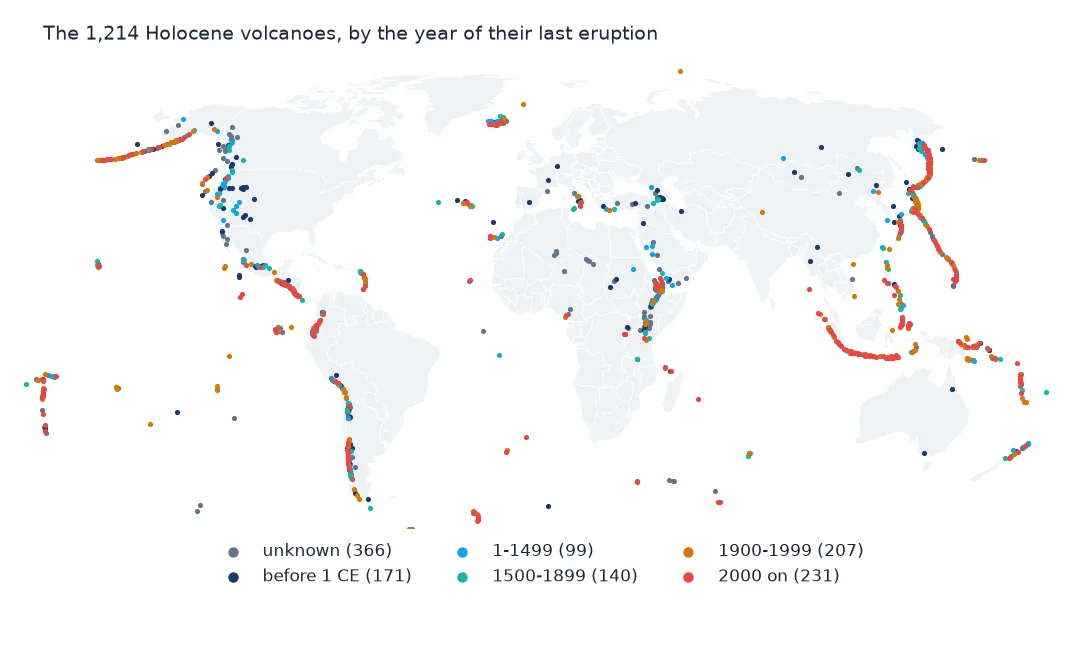
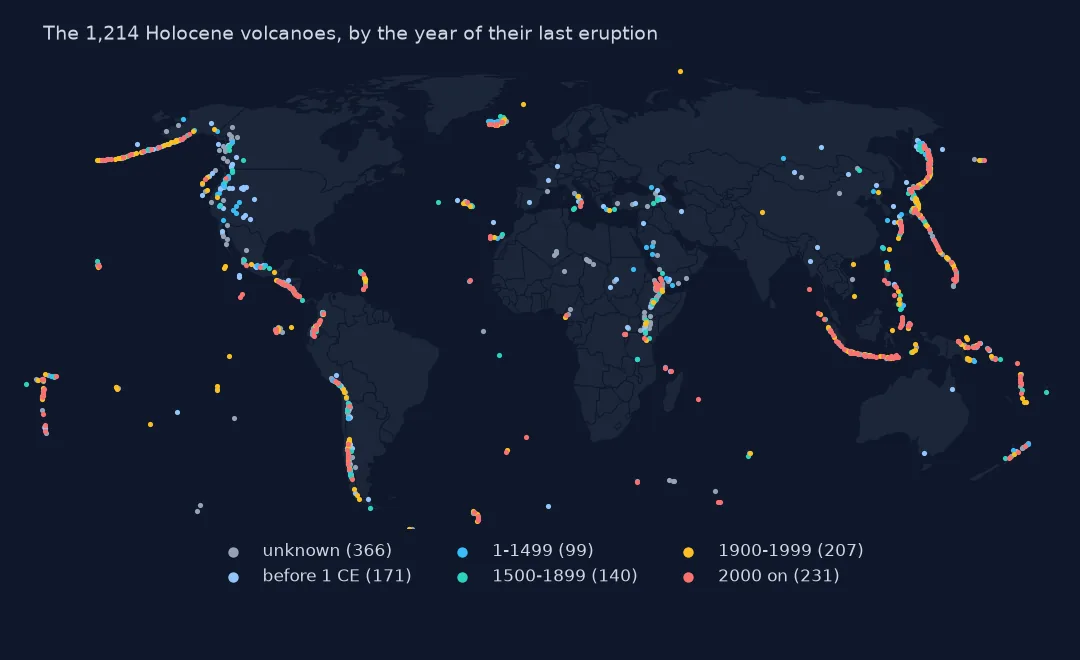
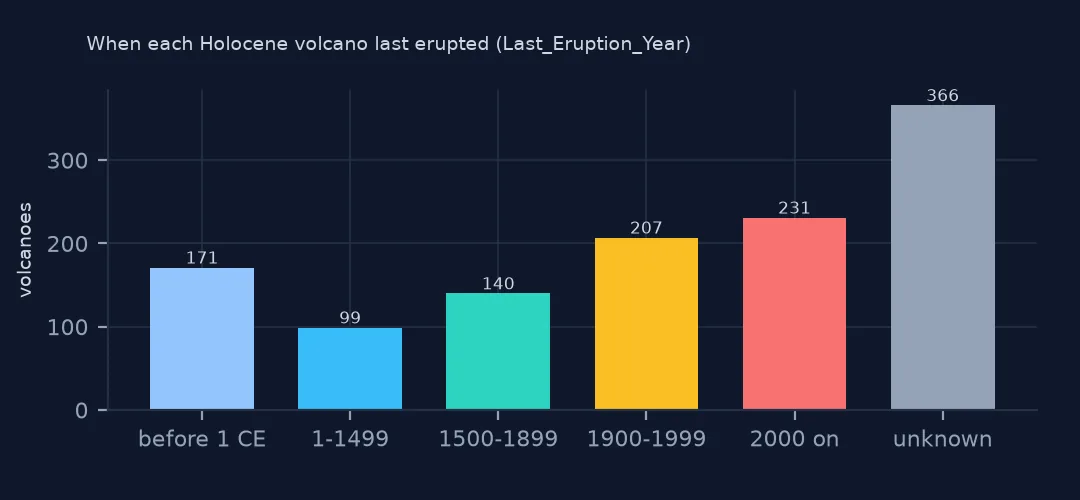
Last_Eruption_Year is not simply the start of the latest eruption: for 145 volcanoes it is the year that eruption ended. Stromboli's current eruption began in 1934, but its last eruption year is 2026, because the eruption was still going at the last report. 171 volcanoes last erupted before the Common Era, 231 have erupted since 2000, and 366 have no known eruption date, though there is evidence they were active in the Holocene.
Example 2: a map
vol["last"] = pd.cut(vol.Last_Eruption_Year, bins, labels=labels).cat.add_categories("unknown").fillna("unknown")
ax = vol.to_crs("+proj=robin").plot(column="last", markersize=4, legend=True, figsize=(12, 6))
ax.set_axis_off()
print(vol.groupby("last", observed=True).size().to_string())
last
before 1 CE 171
1-1499 99
1500-1899 140
1900-1999 207
2000 on 231
unknown 366
On the map, the volcanoes active since 2000 trace the Pacific ring of subduction zones, Indonesia and the Mid-Atlantic in Iceland. The 366 with no known eruption lie in the same belts, most of them in East Africa, the Andes, North and Central America and the northwestern Pacific. They are mostly stratovolcanoes and volcanic fields whose young deposits have not been dated.
Internal links
- What the records hold — evidence categories, dating methods and getting the data without code
- Volcano types and settings — the type and tectonic columns mapped
- Eruption dates — the codes in the month and day columns
- Countries with erupting volcanoes — counting by country