
How to Find Container, Oil and LNG Terminals in the World Port Index
On this page
Problem statement
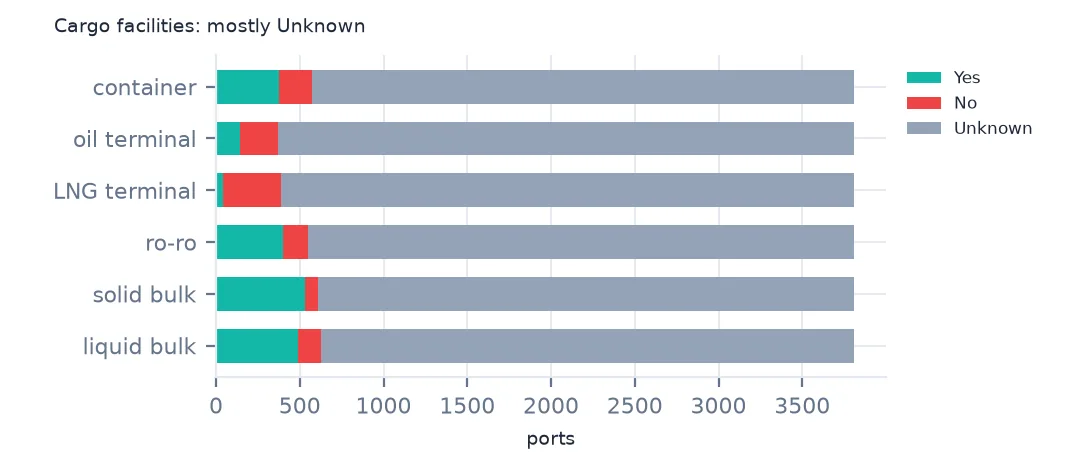
Which ports have container terminals, oil terminals or LNG terminals? The World Port Index answers yes, no or unknown for each of 14 facility types at every port, and the answers are mostly unknown. This page counts the six main cargo facilities, lists where container and LNG terminals are recorded, checks how facilities occur together, and looks at oil terminals that have no harbour at all. The counts are of ports where the index says yes, a floor on the real numbers, not a census.
Quick answer
Count Yes, No and Unknown for six facility columns:
FAC = {"container": "Facilities - Container", "oil terminal": "Facilities - Oil Terminal", "LNG terminal": "Facilities - LNG Terminal", "ro-ro": "Facilities - Ro-Ro", "solid bulk": "Facilities - Solid Bulk", "liquid bulk": "Facilities - Liquid Bulk"}
t = pd.DataFrame({k: ports[c].value_counts() for k, c in FAC.items()}).T[["Yes", "No", "Unknown"]]
print(t.to_string())
Yes No Unknown
container 379 195 3233
oil terminal 143 226 3438
LNG terminal 41 346 3420
ro-ro 399 150 3258
solid bulk 533 78 3196
liquid bulk 490 137 3180
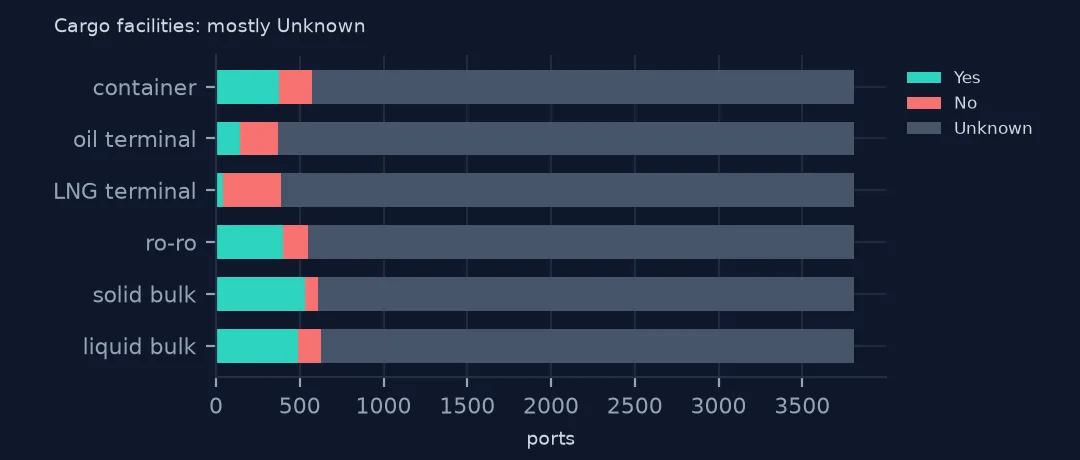
379 ports are recorded with a container facility, 143 with an oil terminal and 41 with an LNG terminal, against 3,233, 3,438 and 3,420 Unknown. Solid bulk has the most yes answers, 533, then liquid bulk with 490 and roll-on roll-off with 399. For every facility, Unknown is the answer at more than four ports in five.
Container ports, LNG and combinations
1. Container ports
cont = ports[ports["Facilities - Container"] == "Yes"]
print(cont["Harbor Size"].value_counts().to_dict())
print(cont["Country Code"].value_counts().head(6).to_string())
{'Small': 132, 'Medium': 100, 'Very Small': 87, 'Large': 47}
Country Code
Norway 34
Australia 25
Sweden 22
Mexico 17
Denmark 15
Finland 14
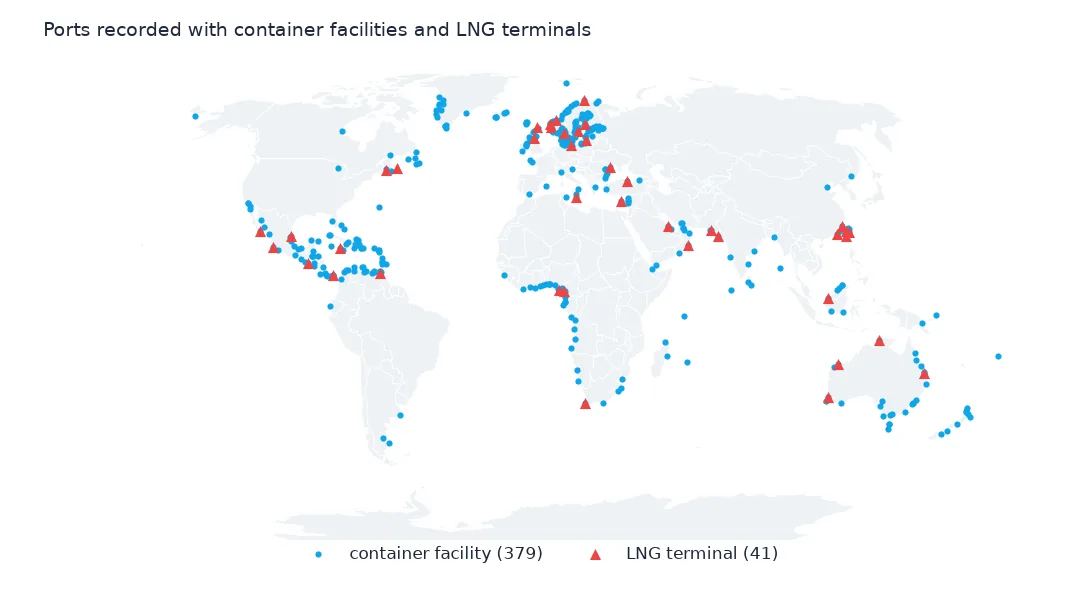
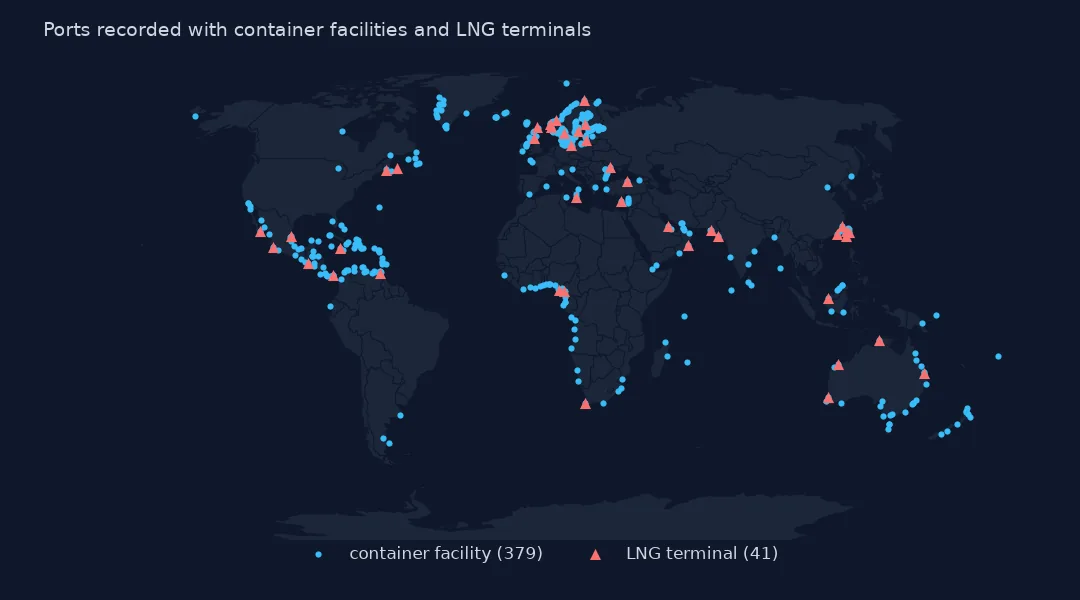
The 379 container ports are not only big ones: 132 are small and 87 very small, against 100 medium and 47 large, because a quay with a crane for a few containers counts. Norway has the most recorded, 34, then Australia, Sweden, Mexico, Denmark and Finland. China, with the world's largest container ports, has 4 recorded, a sign of where the index's facility data is detailed.
2. LNG terminals
lng = ports[ports["Facilities - LNG Terminal"] == "Yes"]
print(lng["Country Code"].value_counts().head(6).to_string())
print(f"LNG terminal depth recorded: {lng['Liquified Natural Gas Terminal Depth (m)'].notna().sum()} of {len(lng)}; median {lng['Liquified Natural Gas Terminal Depth (m)'].median():.1f} m")
Country Code
Norway 4
Australia 4
Mexico 3
Taiwan 3
Sweden 2
United Kingdom 2
LNG terminal depth recorded: 9 of 41; median 13.0 m
Only 41 LNG terminals are recorded, 4 each in Norway and Australia, 3 in Mexico and Taiwan, while the largest LNG exporters and importers, such as Qatar, the United States and Japan, have none recorded. 9 of the 41 have an LNG terminal depth, with a median of 13.0 m. For LNG, use an industry list; the index is not one.
3. Facilities that travel together
yes = ports[list(FAC.values())].eq("Yes").astype(int)
yes.columns = list(FAC)
print((yes.T @ yes).to_string())
container oil terminal LNG terminal ro-ro solid bulk liquid bulk
container 379 96 34 291 326 306
oil terminal 96 143 18 83 100 132
LNG terminal 34 18 41 32 33 36
ro-ro 291 83 32 399 330 303
solid bulk 326 100 33 330 533 384
liquid bulk 306 132 36 303 384 490
Facilities come together. Of the 379 container ports, 326 also have solid bulk and 306 liquid bulk facilities, and 291 ro-ro; of the 41 LNG terminals, 34 are at container ports. The ports where facilities are recorded at all are the well-documented general cargo ports, which is why the overlaps are so large.
Oil terminals without a harbour
The data used on this page
The US National Geospatial-Intelligence Agency's World Port Index (Pub. 150), the CSV served by its Maritime Safety Information site, downloaded on 28 October 2026 and saved on this site, because NGA revises the index as port information changes. A US government publication, free to use. Depths and lengths are in metres.
from pathlib import Path
import zipfile

import geopandas as gpd
import numpy as np
import pandas as pd
import requests

Path("data").mkdir(exist_ok=True)
# NGA's World Port Index (Pub. 150) as CSV, with Natural Earth's populated places, countries and land. Saved
# 28 October 2026: NGA revises the index as port information changes.
# Live: https://msi.nga.mil/api/publications/download?type=view&key=16920959/SFH00000/UpdatedPub150.csv
ARCHIVE = "nga-world-port-index-2026-10-28.zip"
if not Path(f"data/{ARCHIVE}").exists():
    Path(f"data/{ARCHIVE}").write_bytes(requests.get(f"https://data.spatialworkflow.io/{ARCHIVE}", timeout=600).content)
Z = zipfile.ZipFile(f"data/{ARCHIVE}")
for f in ["ne_10m_populated_places_simple.zip", "ne_110m_admin_0_countries.zip", "ne_50m_land.zip"]:
    Path(f"data/{f}").write_bytes(Z.read(f))
wpi = pd.read_csv(Z.open("UpdatedPub150.csv"), encoding="utf-8-sig")
wpi = wpi.replace(r"^\s*$", np.nan, regex=True)                                  # blank cells are a single space
DEPTHS = [c for c in wpi.columns if c.endswith("(m)")]
wpi[DEPTHS] = wpi[DEPTHS].where(wpi[DEPTHS] > 0)                                    # 0 means not recorded
ports = gpd.GeoDataFrame(wpi, geometry=gpd.points_from_xy(wpi.Longitude, wpi.Latitude), crs=4326)
print(f"World Port Index: {len(ports):,} ports in {ports['Country Code'].nunique()} countries and territories")
World Port Index: 3,807 ports in 195 countries and territories
Example 1: oil terminals without a harbour
oil = ports[ports["Facilities - Oil Terminal"] == "Yes"]
print(oil["Harbor Type"].value_counts(dropna=False).head(5).to_dict())
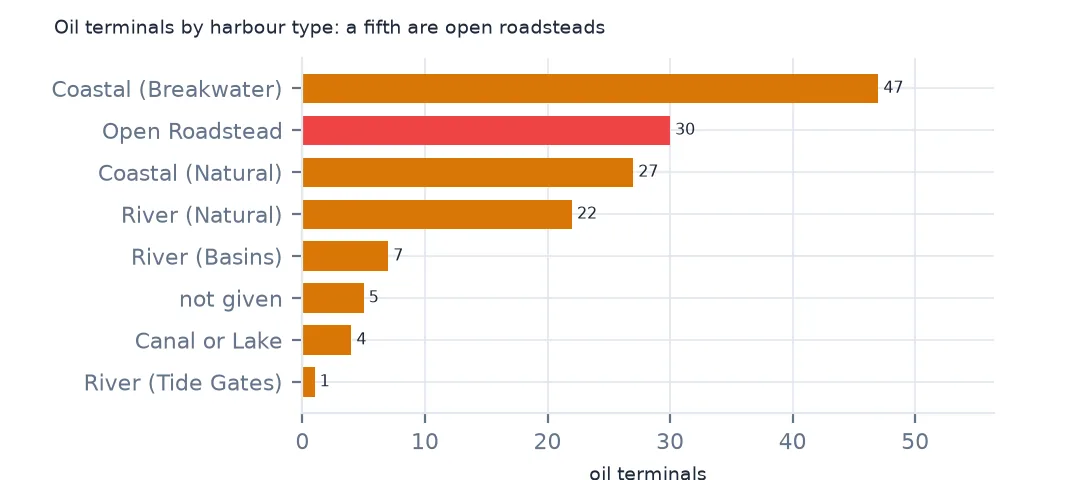
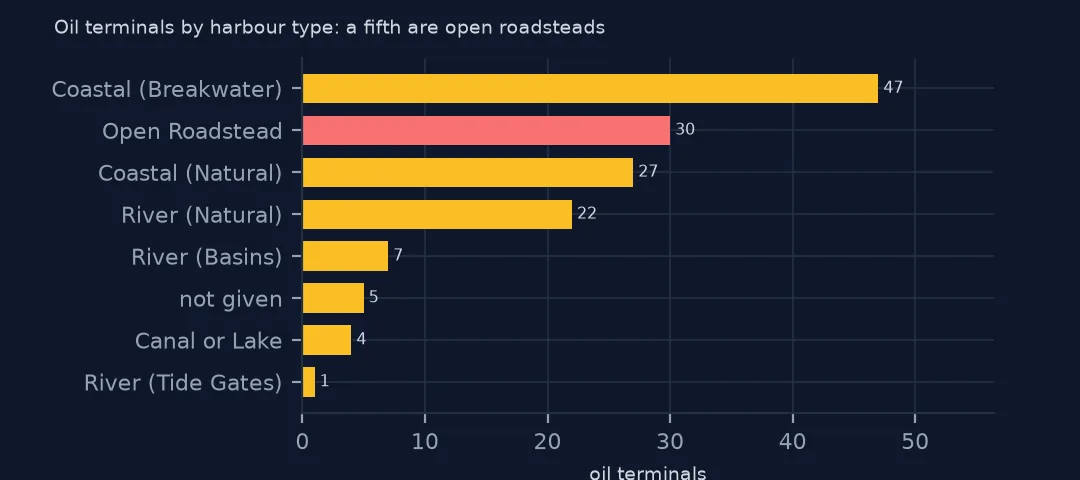
{'Coastal (Breakwater)': 47, 'Open Roadstead': 30, 'Coastal (Natural)': 27, 'River (Natural)': 22, 'River (Basins)': 7}
Of the 143 oil terminals, 47 are in breakwater harbours and 27 in natural coastal harbours, but 30 are open roadsteads, offshore moorings with no harbour at all, and 22 are on rivers. An oil terminal in the index can be a buoy miles off the coast.
Internal links
- Yes, No and Unknown — why the unknowns must stay unknown
- Deep-water ports — the depths at these terminals
- The World Port Index explained — what the index records, and getting the data without code
- Power plants from EIA-860 — where the LNG goes