
How to Find Deep-Water Ports: Channel and Pier Depths in the World Port Index
On this page
Problem statement
The largest container ships and tankers need 15 metres of water or more, and only a few ports can take them. The World Port Index records each port's channel, anchorage, cargo pier, oil terminal and LNG terminal depths, so a list of deep-water ports is a filter on two columns, once the zeros that mean "unknown" are removed. This page finds the ports with deep channels and deep cargo piers, compares depths by harbour size, explains the extreme values, and shows which countries have the deep ports.
Quick answer
Keep the ports with a recorded channel depth and filter on both channel and cargo pier depth:
d = ports[["Main Port Name", "Country Code", "Harbor Size", "Channel Depth (m)", "Cargo Pier Depth (m)"]].dropna(subset=["Channel Depth (m)"])
print(f"ports with a channel depth: {len(d):,} of {len(ports):,}")
print(d["Channel Depth (m)"].describe(percentiles=[0.5, 0.9]).round(1).to_string())
deep = d[(d["Channel Depth (m)"] >= 15) & (d["Cargo Pier Depth (m)"] >= 15)]
print(f"channel and cargo pier both 15 m or deeper: {len(deep)}")
print(f"distinct channel depths: {d['Channel Depth (m)'].nunique()}; most common: {d['Channel Depth (m)'].value_counts().head(6).to_dict()}; 23.2 m in feet: {23.2 / 0.3048:.0f}")
ports with a channel depth: 3,169 of 3,807
count 3169.0
mean 10.2
std 7.2
min 1.0
50% 9.4
90% 21.6
max 200.0
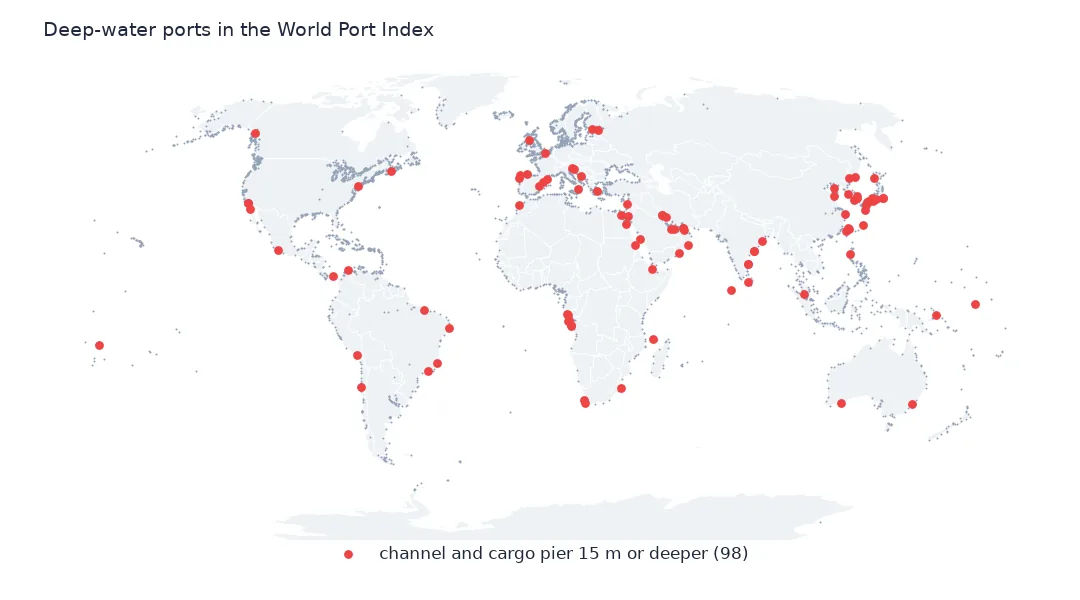
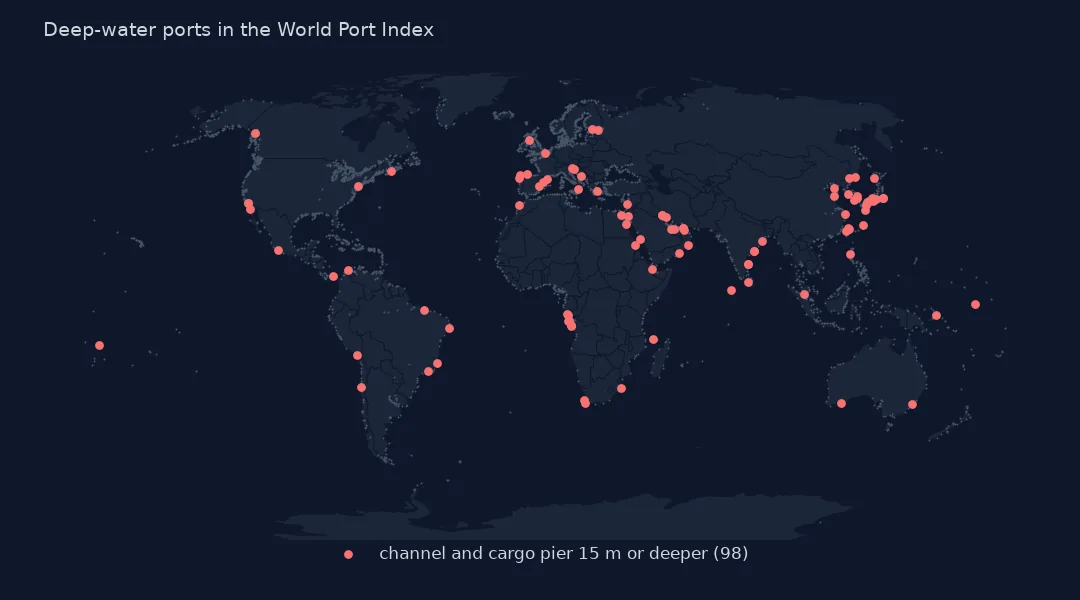
channel and cargo pier both 15 m or deeper: 98
distinct channel depths: 127; most common: {9.4: 337, 7.9: 329, 11.0: 308, 4.9: 294, 23.2: 292, 6.4: 290}; 23.2 m in feet: 76
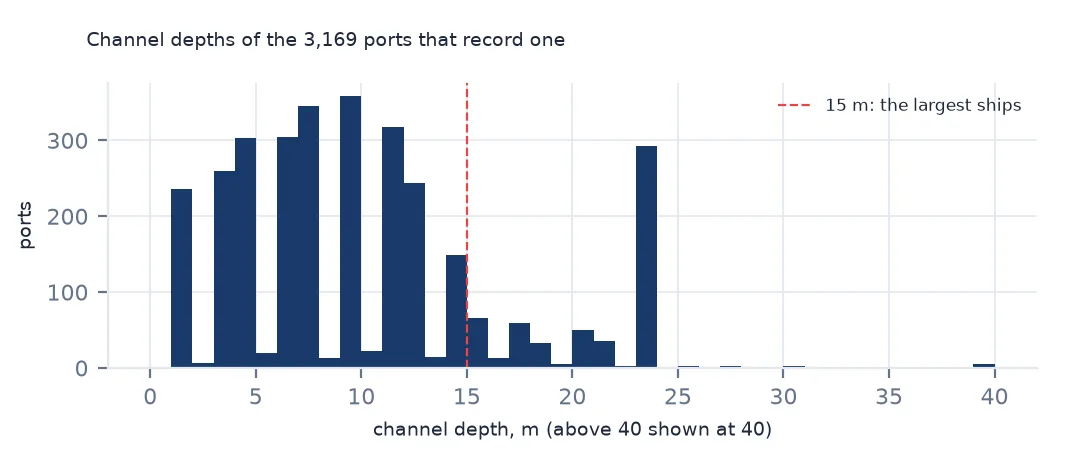
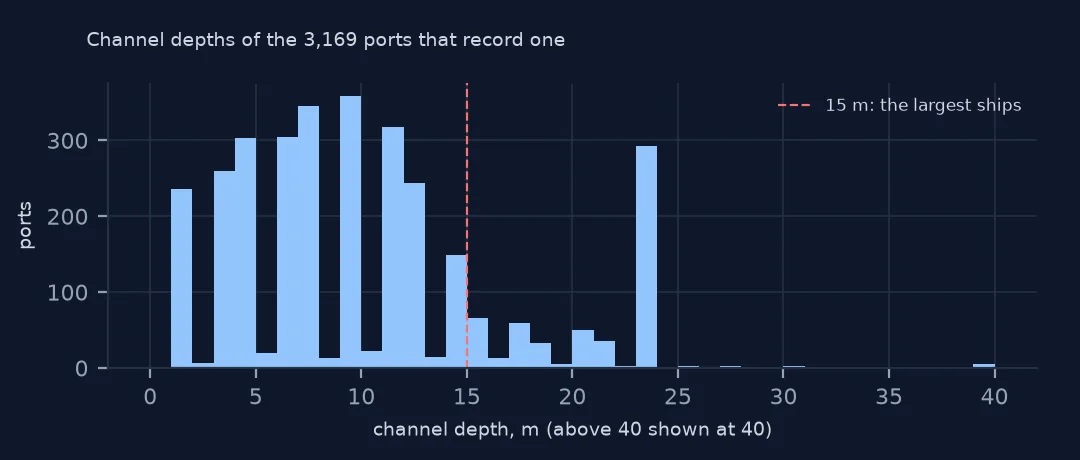
3,169 of the 3,807 ports have a channel depth. The median is 9.4 m and a tenth of ports have 21.6 m or more, but the maximum, 200 m, is not a channel. Only 98 ports have both a channel and a cargo pier 15 m deep or more, the short list that can take the largest ships alongside. The depths are not measurements but classes: of 127 distinct values, the common ones, 9.4, 7.9, 11.0, 4.9 and 6.4 m, are about 1.5 m, five feet, apart, the depth bands of the printed index converted to metres. 23.2 m, 76 feet, is the top band, "76 feet and over", so a port listed at 23.2 m may be much deeper.
Size, extremes and countries
1. Depth by harbour size
print(ports.groupby("Harbor Size")[["Channel Depth (m)", "Cargo Pier Depth (m)", "Oil Terminal Depth (m)"]].median().round(1).to_string()) Channel Depth (m) Cargo Pier Depth (m) Oil Terminal Depth (m)
Harbor Size
Large 12.5 11.0 11.0
Medium 11.0 11.0 10.2
Small 9.4 7.9 9.4
Very Small 7.9 6.4 9.4
Depth rises with harbour size, but less than expected: the median large port has a 12.5 m channel and an 11.0 m cargo pier, the median very small port 7.9 m and 6.4 m. Large ports are large for their facilities and traffic, and an old estuary port can be shallower than a small harbour in a deep fjord.
2. The deepest records, and why some are not harbours
print(ports.nlargest(5, "Channel Depth (m)")[["Main Port Name", "Country Code", "Harbor Type", "Channel Depth (m)", "Cargo Pier Depth (m)"]].to_string(index=False)) Main Port Name Country Code Harbor Type Channel Depth (m) Cargo Pier Depth (m)
Yombo Terminal Congo (Brazzaville) Open Roadstead 200.0 NaN
Takula Terminal Angola Open Roadstead 70.0 NaN
Su-Ao Taiwan Coastal (Breakwater) 62.0 12.0
Stodhvarfjordur Iceland NaN 55.0 NaN
Akureyri Iceland Coastal (Natural) 47.0 11.0
The deepest channel records are offshore terminals and fjords, not harbours: Yombo Terminal off Congo-Brazzaville with 200 m and Takula Terminal off Angola with 70 m are offshore oil terminals in open roadsteads, and Stodhvarfjordur and Akureyri in Iceland lie in deep fjords. For a list of harbours a large ship can enter, filter on cargo pier depth too, which these records lack or keep modest.
3. Which countries have deep ports
print(deep["Country Code"].value_counts().head(8).to_string())Country Code
Japan 12
Angola 6
Spain 6
India 5
United States 4
Brazil 4
South Korea 4
China 3
Japan has the most of the 98 deep ports, 12, then Angola and Spain with 6 each, India with 5 and the United States, Brazil and South Korea with 4. The list is short because both depths must be recorded and both must reach 15 m.
The depth classes
The data used on this page
The US National Geospatial-Intelligence Agency's World Port Index (Pub. 150), the CSV served by its Maritime Safety Information site, downloaded on 28 October 2026 and saved on this site, because NGA revises the index as port information changes. A US government publication, free to use. Depths and lengths are in metres.
from pathlib import Path
import zipfile

import geopandas as gpd
import numpy as np
import pandas as pd
import requests

Path("data").mkdir(exist_ok=True)
# NGA's World Port Index (Pub. 150) as CSV, with Natural Earth's populated places, countries and land. Saved
# 28 October 2026: NGA revises the index as port information changes.
# Live: https://msi.nga.mil/api/publications/download?type=view&key=16920959/SFH00000/UpdatedPub150.csv
ARCHIVE = "nga-world-port-index-2026-10-28.zip"
if not Path(f"data/{ARCHIVE}").exists():
    Path(f"data/{ARCHIVE}").write_bytes(requests.get(f"https://data.spatialworkflow.io/{ARCHIVE}", timeout=600).content)
Z = zipfile.ZipFile(f"data/{ARCHIVE}")
for f in ["ne_10m_populated_places_simple.zip", "ne_110m_admin_0_countries.zip", "ne_50m_land.zip"]:
    Path(f"data/{f}").write_bytes(Z.read(f))
wpi = pd.read_csv(Z.open("UpdatedPub150.csv"), encoding="utf-8-sig")
wpi = wpi.replace(r"^\s*$", np.nan, regex=True)                                  # blank cells are a single space
DEPTHS = [c for c in wpi.columns if c.endswith("(m)")]
wpi[DEPTHS] = wpi[DEPTHS].where(wpi[DEPTHS] > 0)                                    # 0 means not recorded
ports = gpd.GeoDataFrame(wpi, geometry=gpd.points_from_xy(wpi.Longitude, wpi.Latitude), crs=4326)
print(f"World Port Index: {len(ports):,} ports in {ports['Country Code'].nunique()} countries and territories")
World Port Index: 3,807 ports in 195 countries and territories
Example 1: the depth classes the index uses for ships
bins = [0, 5, 10, 15, 20, 300]
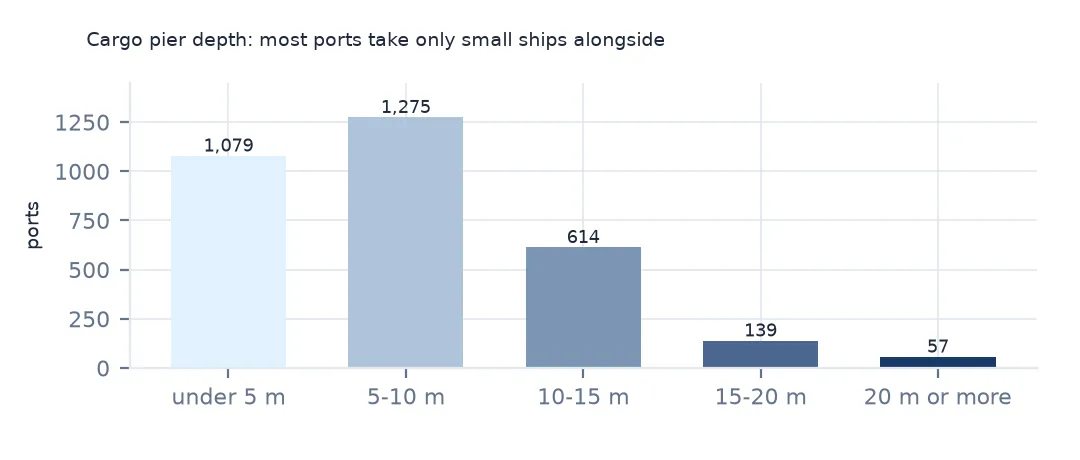
print(pd.cut(ports["Cargo Pier Depth (m)"], bins, labels=["under 5 m", "5-10 m", "10-15 m", "15-20 m", "20 m or more"]).value_counts(sort=False).to_string())
Cargo Pier Depth (m)
under 5 m 1079
5-10 m 1275
10-15 m 614
15-20 m 139
20 m or more 57
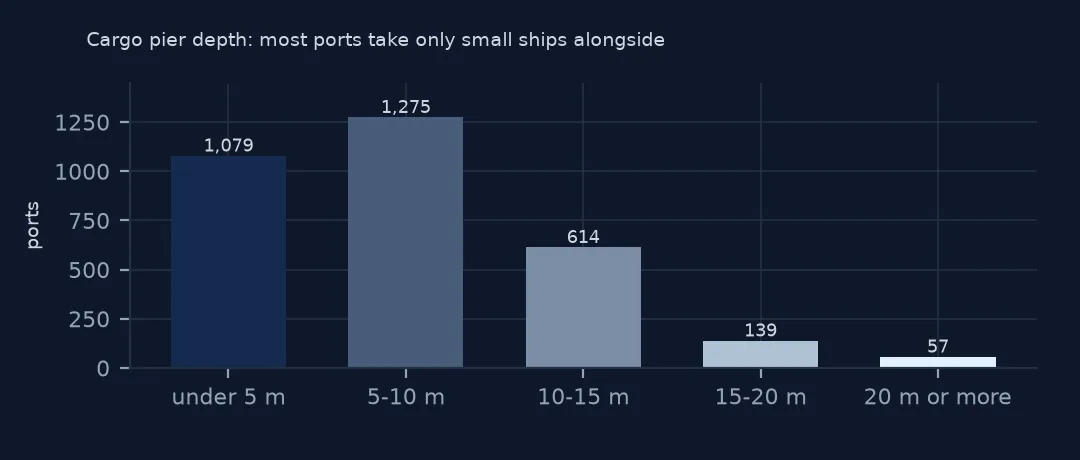
By cargo pier depth, 1,079 ports have less than 5 m, 1,275 between 5 and 10 m and 614 between 10 and 15 m. Only 139 have 15 to 20 m and 57 have 20 m or more. Most of the world's ports can take only coasters and fishing boats at their piers.
Internal links
- Depths stored as 0 — why zeros are removed first
- Container and LNG terminals — the facilities at deep ports
- Reading the index — the measurement columns
- Bathymetry explained — depth beyond the port