
Fixing Bank Branch Counts That Include Drive-Throughs and Offices Without Tellers
On this page
Problem statement
The Summary of Deposits calls every place a bank does business an office, and a branch count that takes all of them includes drive-up windows, trust offices, administrative buildings, mobile branches and "home banking" offices that are websites. The column that separates them, BRSERTYP, holds a numeric code with no label in the data. This page decodes it from the FDIC's own definitions, counts each type with its deposits, checks the limited offices by name, and shows how much the choice changes a count, between states and between years.
Quick answer
Label the codes and count offices and median deposits by type:
TYPES = {11: "full service, brick and mortar", 12: "full service, retail", 13: "full service, home banking", 21: "limited, administrative",
         22: "limited, military facility", 23: "limited, drive-through or detached", 29: "limited, mobile or seasonal", 30: "limited, trust"}
t = sod.groupby("BRSERTYP").agg(offices=("UNINUMBR", "size"), median_deposits_m=("deposits", lambda s: s.median() / 1e6))
t.index = t.index.map(lambda k: f"{k} {TYPES.get(k, '?')}")
print(t.round(1).to_string())
offices median_deposits_m
BRSERTYP
11 full service, brick and mortar 71242 84.5
12 full service, retail 2388 14.6
13 full service, home banking 182 7.0
21 limited, administrative 287 0.0
22 limited, military facility 2 15.8
23 limited, drive-through or detached 1449 0.0
29 limited, mobile or seasonal 357 0.0
30 limited, trust 190 0.0
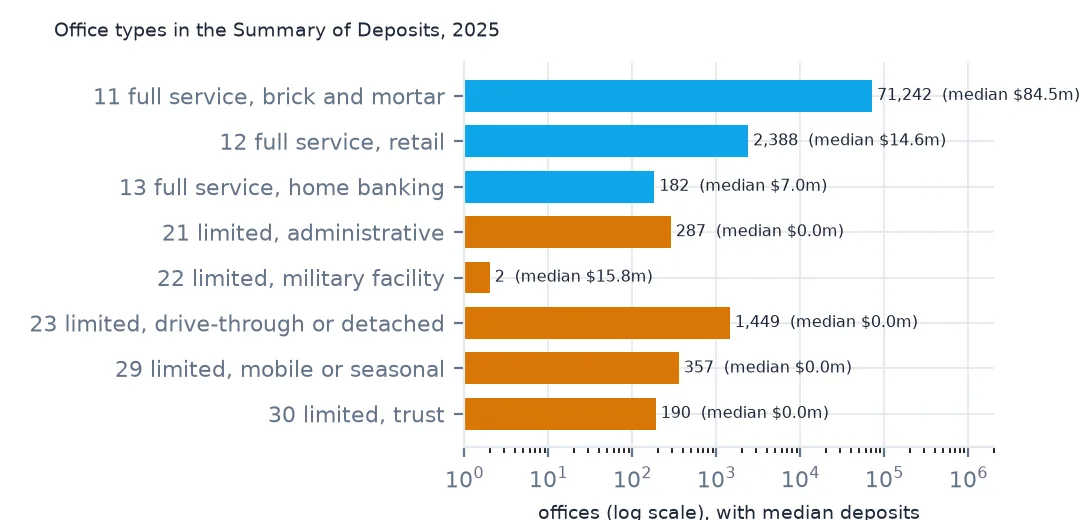
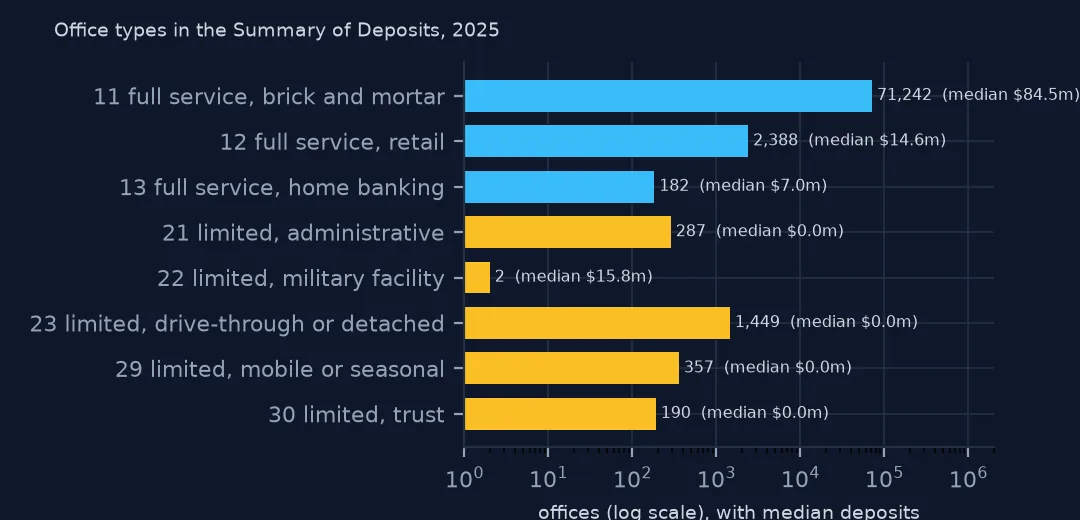
The codes come in two families: 11 to 13 are full-service offices, 21 to 30 limited-service ones. Full-service brick-and-mortar branches are 71,242 of the 76,097 offices, with a median of $84.5 million in deposits, and retail offices in shops 2,388 with $14.6 million. Every limited type except military facilities has a median of zero: drive-throughs, administrative, mobile and trust offices take no deposits of their own, because the money is booked at a parent branch.
What the limited offices are, and what the choice changes
1. What the limited offices are
for k in [23, 21, 13]:
    print(k, sod[sod.BRSERTYP == k].NAMEBR.str.lower().str.extract(r"(drive|motor|atm|operations|online|internet|digital|trust)")[0].value_counts().head(3).to_dict())
23 {'drive': 486, 'motor': 102, 'operations': 6}
21 {'operations': 23, 'trust': 10, 'drive': 2}
13 {'internet': 14, 'online': 11, 'digital': 4}
The names confirm the codes. Of the drive-through and detached offices, 486 have "drive" in their name and 102 "motor", as in motor bank; administrative offices include operations centres and trust offices; home-banking offices are called internet, online or digital branches. These are not places a customer can open an account at a counter.
2. How much the count changes
full = sod.BRSERTYP.isin([11, 12])
print(f"all offices: {len(sod):,}; full-service walk-in offices: {full.sum():,} ({full.mean():.1%})")
by = sod.groupby("STALPBR").apply(lambda d: 1 - d.BRSERTYP.isin([11, 12]).mean())
print(by.sort_values(ascending=False).head(5).map("{:.1%}".format).to_string())
all offices: 76,097; full-service walk-in offices: 73,630 (96.8%)
STALPBR
MP 16.7%
DE 13.0%
NE 8.4%
OK 7.2%
GU 6.2%
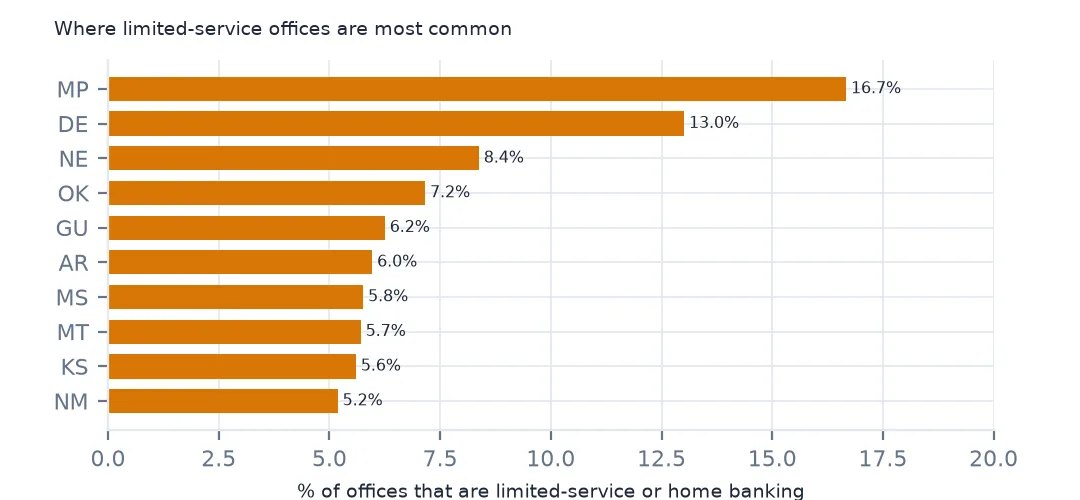
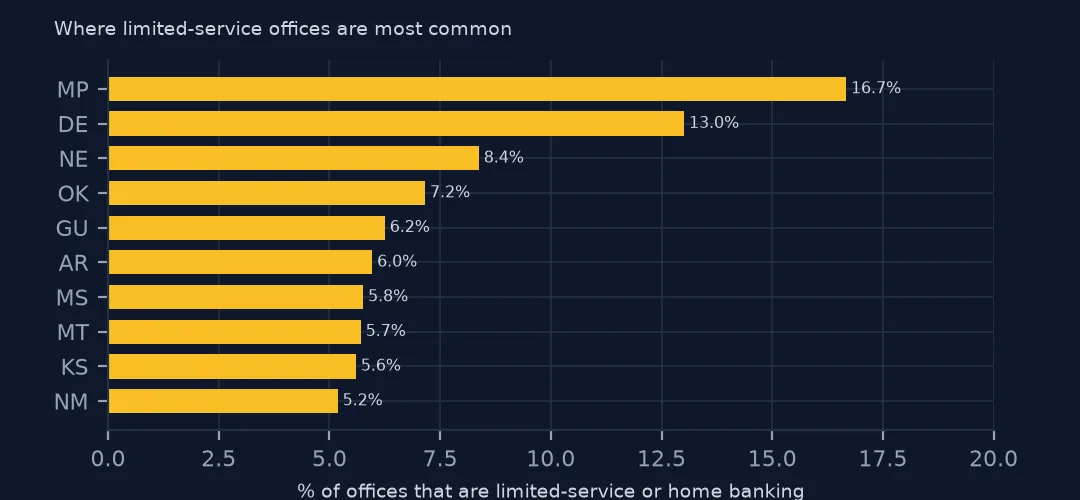
Counting full-service walk-in offices, codes 11 and 12, keeps 73,630 of the 76,097 offices, 96.8%. The share of limited offices differs between places: a sixth of offices in the Northern Mariana Islands, 13.0% in Delaware, mostly mobile, administrative and trust offices, and 8.4% in Nebraska and 7.2% in Oklahoma, mostly drive-throughs. A state comparison of all offices overstates those places.
3. Online 'branches' that hold deposits
o = sod[sod.BRSERTYP == 13]
print(f"home-banking offices: {len(o)}, deposits ${o.deposits.sum() / 1e9:,.0f} billion")
print(o.nlargest(3, "deposits").assign(bn=lambda d: (d.deposits / 1e9).round(0))[["NAMEFULL", "CITYBR", "STALPBR", "bn"]].to_string(index=False))
home-banking offices: 182, deposits $906 billion
NAMEFULL CITYBR STALPBR bn
Capital One, National Association Wilmington DE 274.0
Charles Schwab Bank, SSB Westlake TX 210.0
Ally Bank Sandy UT 151.0
The 182 home-banking offices hold $906 billion of deposits, as much as all of Florida's branches. Capital One's internet branch in Wilmington books $274 billion, Charles Schwab's bank $210 billion and Ally Bank, in Sandy, Utah, $151 billion. They count as full-service offices in the codes, but they have no counter and no neighbourhood; leave code 13 out of branch maps and keep it in deposit totals.
A count that changed with the definition
The data used on this page
The FDIC's Summary of Deposits for 2015 and 2025, every office of every FDIC-insured institution with its deposits as of 30 June, from the BankFind Suite API, downloaded on 28 October 2026 and saved on this site, because banks amend past reports and the API serves the revised figures. Public domain. Deposits are reported in thousands of dollars.
from pathlib import Path
import zipfile

import geopandas as gpd
import numpy as np
import pandas as pd
import requests

Path("data").mkdir(exist_ok=True)
# FDIC Summary of Deposits for 2015 and 2025 (every branch, deposits as of 30 June) from the BankFind Suite API, with
# the Census Bureau's 2024 county population estimates, 2020 tract centres of population, counties and states.
# Saved 28 October 2026: the API serves revised years as banks amend their reports.
# Live: https://api.fdic.gov/banks/sod?filters=YEAR:2025&limit=10000&offset=0
ARCHIVE = "fdic-sod-2026-10-28.zip"
if not Path(f"data/{ARCHIVE}").exists():
    Path(f"data/{ARCHIVE}").write_bytes(requests.get(f"https://data.spatialworkflow.io/{ARCHIVE}", timeout=600).content)
Z = zipfile.ZipFile(f"data/{ARCHIVE}")
for f in ["cb_2024_us_county_20m.zip", "cb_2024_us_state_20m.zip"]:
    Path(f"data/{f}").write_bytes(Z.read(f))
def read_sod(year):
    d = pd.read_csv(Z.open(f"fdic-sod-{year}.csv"), dtype={"ZIPBR": str})
    d["STCNTYBR"] = d.STCNTYBR.astype(str).str.zfill(5)          # county FIPS, stored as a number
    d["deposits"] = d.DEPSUMBR * 1000                              # reported in thousands of dollars
    return d
sod = read_sod(2025)
print(f"FDIC Summary of Deposits 2025: {len(sod):,} offices, ${sod.deposits.sum() / 1e12:,.2f} trillion in deposits")
FDIC Summary of Deposits 2025: 76,097 offices, $18.10 trillion in deposits
Example 1: a count that changed with the definition
old = read_sod(2015)
for y, d in [(2015, old), (2025, sod)]:
    print(y, f"all {len(d):,}; full service {d.BRSERTYP.isin([11, 12]).sum():,}; drive-through {(d.BRSERTYP == 23).sum():,}")
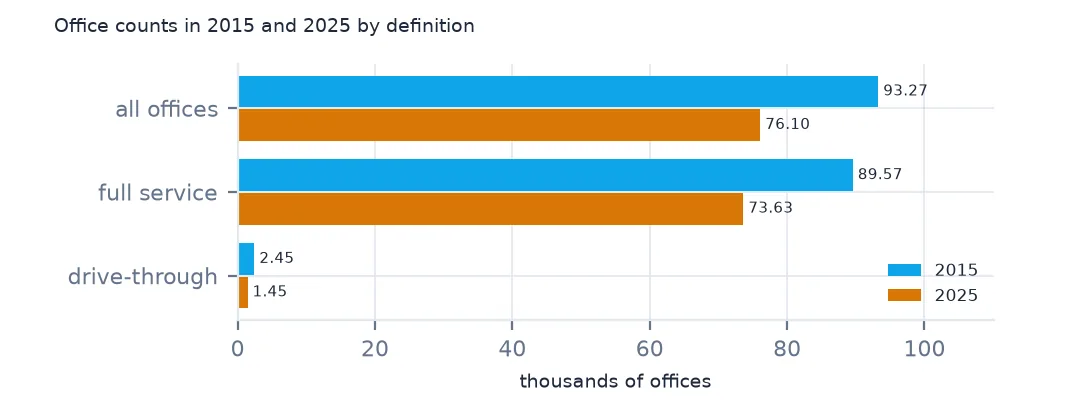
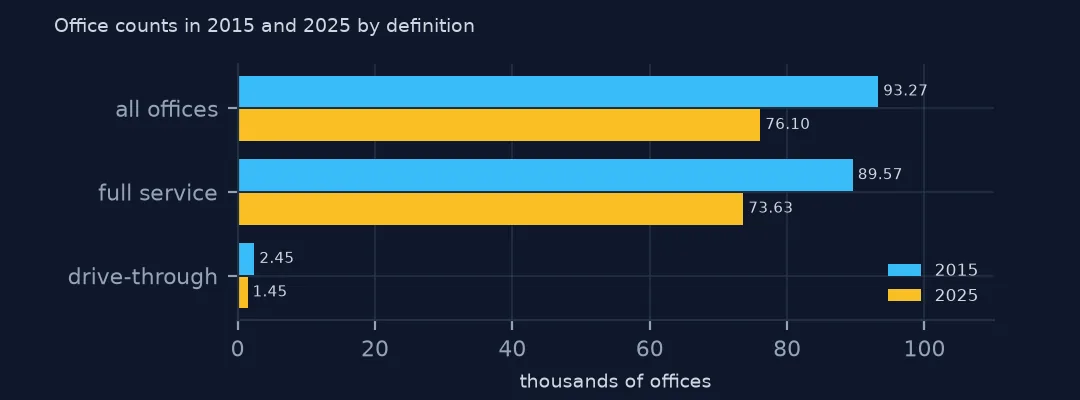
2015 all 93,272; full service 89,566; drive-through 2,448
2025 all 76,097; full service 73,630; drive-through 1,449
Between 2015 and 2025 all offices fell from 93,272 to 76,097 and full-service offices from 89,566 to 73,630, a similar fall, while drive-throughs fell faster, from 2,448 to 1,449. A trend in "branches" is robust to the definition here, but a level is not: always say which codes you counted.
Internal links
- The Summary of Deposits explained — the survey, and getting the data without code
- Branches per resident — a count that uses full service only
- Deposits booked at head offices — the internet offices' deposits
- Branch closures since 2015 — which types were lost