
How to Read FDIC Summary of Deposits Branch Data in Python
On this page
Problem statement
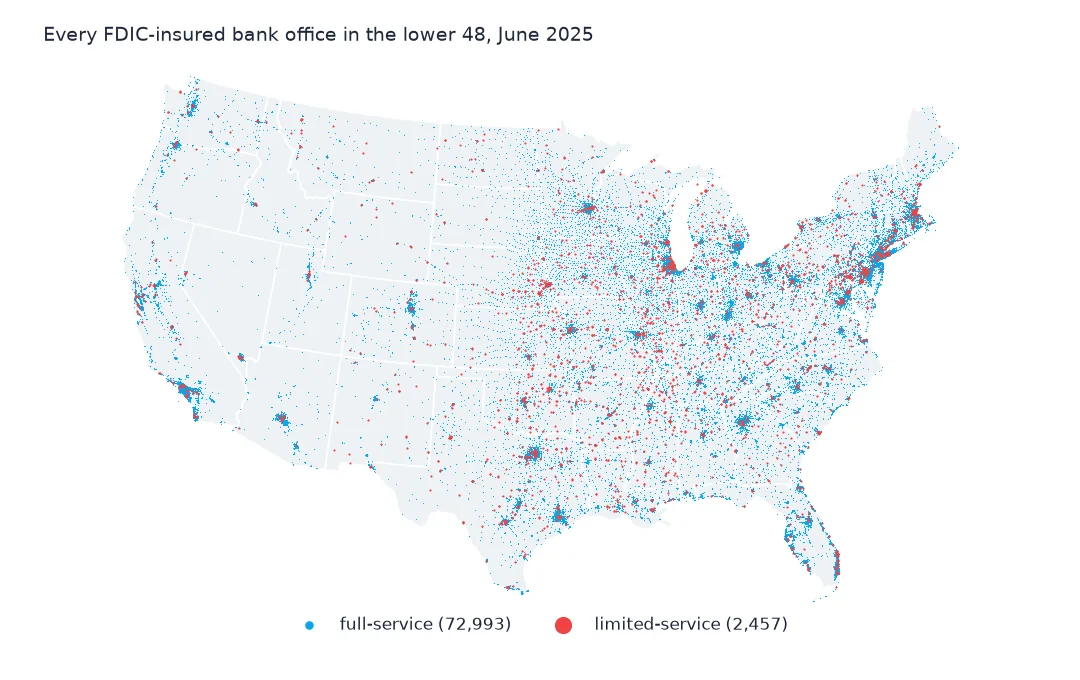
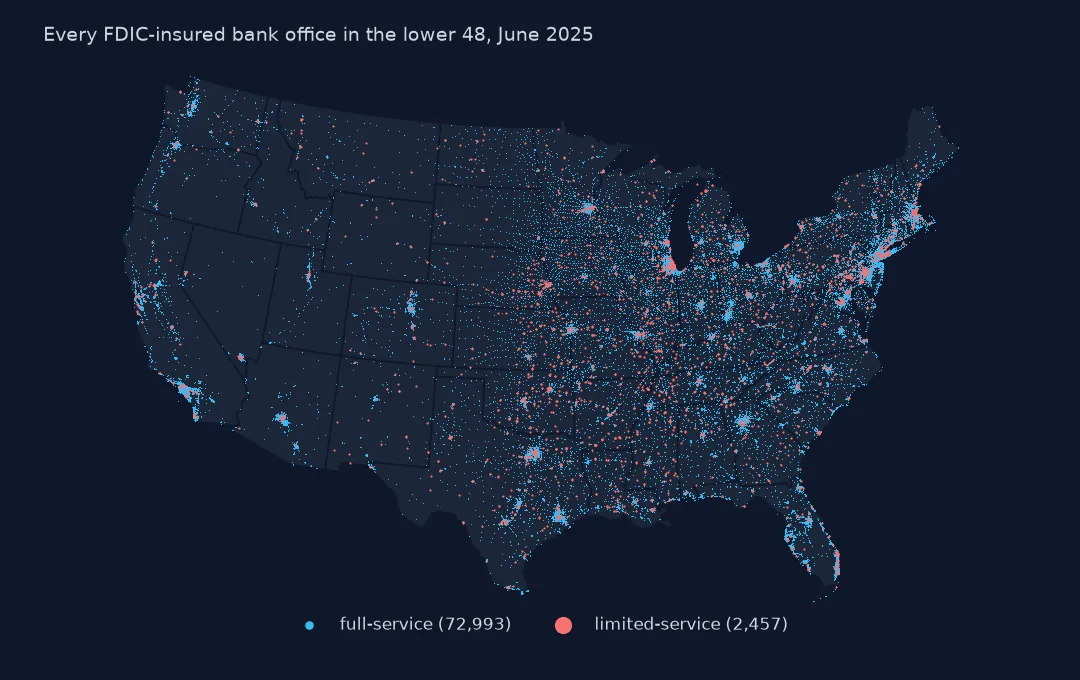
Every June, every FDIC-insured bank and savings institution reports the deposits held at each of its offices. The FDIC publishes the result as the Summary of Deposits: 76,097 offices for 2025, each with its bank, address, county, coordinates, type of office and deposits. It is the only public list of every bank branch in the country, and the standard source for branch maps, closure counts and deposit market shares. Read from the API's CSV, it has three traps before any analysis starts: county and ZIP codes stored as numbers, deposits in thousands of dollars, and a few coordinates that are not where they say. This page reads it and deals with each.
Quick answer
Read the CSV and look at the types pandas gives the code columns:
print(sod[["NAMEFULL", "NAMEBR", "CITYBR", "STALPBR", "STCNTYBR", "BRSERTYP", "DEPSUMBR"]].head(3).to_string(index=False))
print(sod.dtypes[["STCNTYBR", "ZIPBR", "DEPSUMBR", "SIMS_LATITUDE"]].to_string())
NAMEFULL NAMEBR CITYBR STALPBR STCNTYBR BRSERTYP DEPSUMBR
Bank of America, National Association Portland - One City Center Branch Portland ME 23005 11 1049689
The Camden National Bank Ellsworth Branch Ellsworth ME 23009 11 103853
State Street Bank and Trust Company State Street Bank And Trust Company Boston MA 25025 11 207849000
STCNTYBR int64
ZIPBR int64
DEPSUMBR int64
SIMS_LATITUDE float64
The first rows show the range: a Bank of America branch in Portland, Maine, with 1,049,689 in DEPSUMBR, and State Street's Boston office with 207,849,000. The county code STCNTYBR and the ZIP code ZIPBR arrive as integers, so 23005 is fine but every county in a state with a FIPS code below 10 has lost its leading zero.
Codes, units, ids and points
1. Codes that lost their zeros
print(sod.STCNTYBR.astype(str).str.len().value_counts().to_dict(), sod.ZIPBR.astype(str).str.len().value_counts().to_dict())
sod["STCNTYBR"] = sod.STCNTYBR.astype(str).str.zfill(5)
sod["ZIPBR"] = sod.ZIPBR.astype(str).str.zfill(5)
print(sod.loc[sod.STALPBR == "AL", ["CITYBR", "STCNTYBR", "ZIPBR"]].head(2).to_string(index=False))
{5: 64609, 4: 11488} {5: 69468, 4: 6347, 3: 282}
CITYBR STCNTYBR ZIPBR
Auburn 01081 36830
Abbeville 01067 36310
11,488 county codes have four digits and 6,347 ZIP codes four, with 282 ZIP codes of three digits from Puerto Rico and the Virgin Islands. Padding both to five characters restores them: Auburn, Alabama, is county 01081 and ZIP 36830 again. Without it, a join to county boundaries silently drops Alabama, Alaska, Arizona, Arkansas, California, Colorado and Connecticut.
2. Deposits in thousands
print(f"sum of DEPSUMBR: {sod.DEPSUMBR.sum():,}; in dollars: ${sod.DEPSUMBR.sum() * 1000 / 1e12:,.2f} trillion")
print((sod.DEPSUMBR / 1000).describe(percentiles=[0.5, 0.99]).round(1).rename("$ million").to_string())
print(f"offices with no deposits: {(sod.DEPSUMBR == 0).sum():,}")
sum of DEPSUMBR: 18,103,110,848; in dollars: $18.10 trillion
count 76097.0
mean 237.9
std 4661.3
min 0.0
50% 79.2
99% 1181.9
max 727192.4
offices with no deposits: 2,229
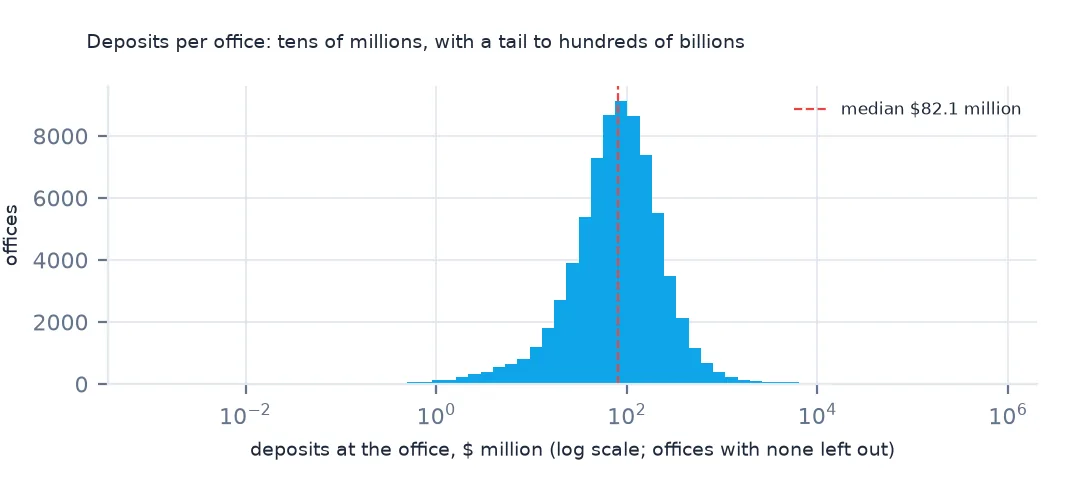
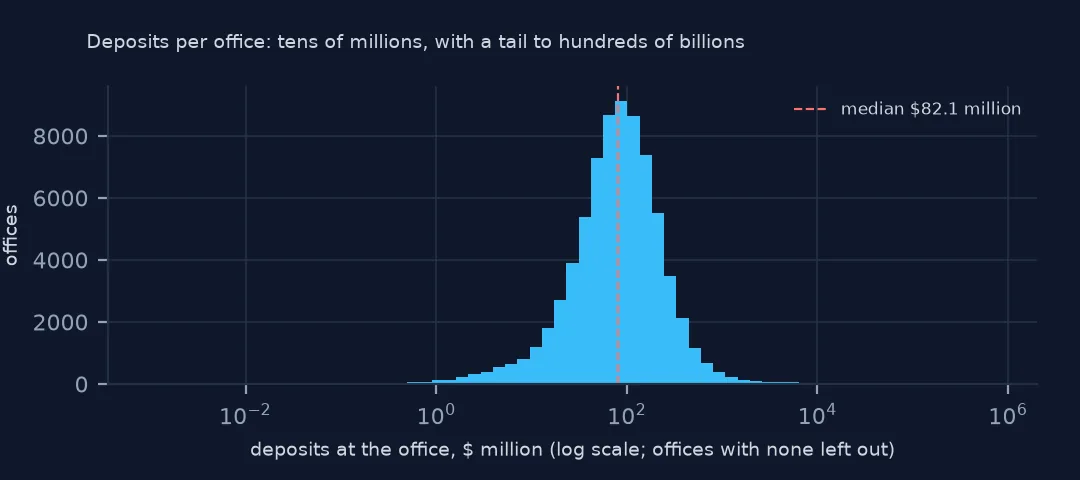
DEPSUMBR is in thousands of dollars, so its sum, 18,103,110,848, is $18.10 trillion of domestic deposits. The median office holds $79.2 million, the 99th percentile $1,181.9 million, and the largest, a JPMorgan Chase branch in Manhattan, $727,192.4 million. 2,229 offices report no deposits at all: they are offices that take no deposits of their own, such as drive-throughs and administrative sites.
3. Offices, banks and holding companies
print(f"offices: {len(sod):,}; UNINUMBR unique: {sod.UNINUMBR.is_unique}; institutions (CERT): {sod.CERT.nunique():,}; holding companies: {sod.RSSDHCR.replace(0, np.nan).nunique():,}")
print(f"main offices (BRNUM 0): {(sod.BRNUM == 0).sum():,}; institutions without a holding company: {sod.loc[sod.RSSDHCR == 0, 'CERT'].nunique():,}")
offices: 76,097; UNINUMBR unique: True; institutions (CERT): 4,431; holding companies: 3,484
main offices (BRNUM 0): 4,431; institutions without a holding company: 711
UNINUMBR is the FDIC's unique id for an office and CERT the id of the institution. The 76,097 offices belong to 4,431 institutions in 3,484 holding companies, and every institution has exactly one main office, numbered 0 in BRNUM. 711 institutions have no holding company, recorded as 0 in RSSDHCR, which is why it is replaced with a missing value before counting.
4. Points
g = gpd.GeoDataFrame(sod, geometry=gpd.points_from_xy(sod.SIMS_LONGITUDE, sod.SIMS_LATITUDE), crs=4326)
print(f"no coordinates: {g.SIMS_LATITUDE.isna().sum()}; bounds: {g.total_bounds.round(1).tolist()}")
print(g.STALPBR.value_counts().head(5).to_dict())
no coordinates: 0; bounds: [-166.2, 5.3, 163.0, 158.2]
{'TX': 6218, 'CA': 5491, 'FL': 4257, 'NY': 4013, 'IL': 3619}
Every office has coordinates, but the bounds run to a latitude of 158.2, which no place has. Two offices on Yap in Micronesia have latitude and longitude swapped; the coordinates page finds them. The table covers the territories and the freely associated states too, so filter by state before mapping the 50 states.
Offices by state and by kind of bank
The data used on this page
The FDIC's Summary of Deposits for 2015 and 2025, every office of every FDIC-insured institution with its deposits as of 30 June, from the BankFind Suite API, downloaded on 28 October 2026 and saved on this site, because banks amend past reports and the API serves the revised figures. Public domain. Deposits are reported in thousands of dollars.
from pathlib import Path
import zipfile

import geopandas as gpd
import numpy as np
import pandas as pd
import requests

Path("data").mkdir(exist_ok=True)
# FDIC Summary of Deposits for 2015 and 2025 (every branch, deposits as of 30 June) from the BankFind Suite API, with
# the Census Bureau's 2024 county population estimates, 2020 tract centres of population, counties and states.
# Saved 28 October 2026: the API serves revised years as banks amend their reports.
# Live: https://api.fdic.gov/banks/sod?filters=YEAR:2025&limit=10000&offset=0
ARCHIVE = "fdic-sod-2026-10-28.zip"
if not Path(f"data/{ARCHIVE}").exists():
    Path(f"data/{ARCHIVE}").write_bytes(requests.get(f"https://data.spatialworkflow.io/{ARCHIVE}", timeout=600).content)
Z = zipfile.ZipFile(f"data/{ARCHIVE}")
for f in ["cb_2024_us_county_20m.zip", "cb_2024_us_state_20m.zip"]:
    Path(f"data/{f}").write_bytes(Z.read(f))
sod = pd.read_csv(Z.open("fdic-sod-2025.csv"))
print(f"FDIC Summary of Deposits 2025: {len(sod):,} offices of {sod.CERT.nunique():,} institutions")
FDIC Summary of Deposits 2025: 76,097 offices of 4,431 institutions
Example 1: offices by state
st = sod.groupby("STALPBR").agg(offices=("UNINUMBR", "size"), deposits_bn=("DEPSUMBR", lambda s: s.sum() / 1e6)).sort_values("offices", ascending=False)
print(st.head(8).round(1).to_string())
offices deposits_bn
STALPBR
TX 6218 1498.2
CA 5491 1796.6
FL 4257 859.2
NY 4013 2613.7
IL 3619 704.5
PA 3339 563.2
OH 3021 565.3
NJ 2256 436.8
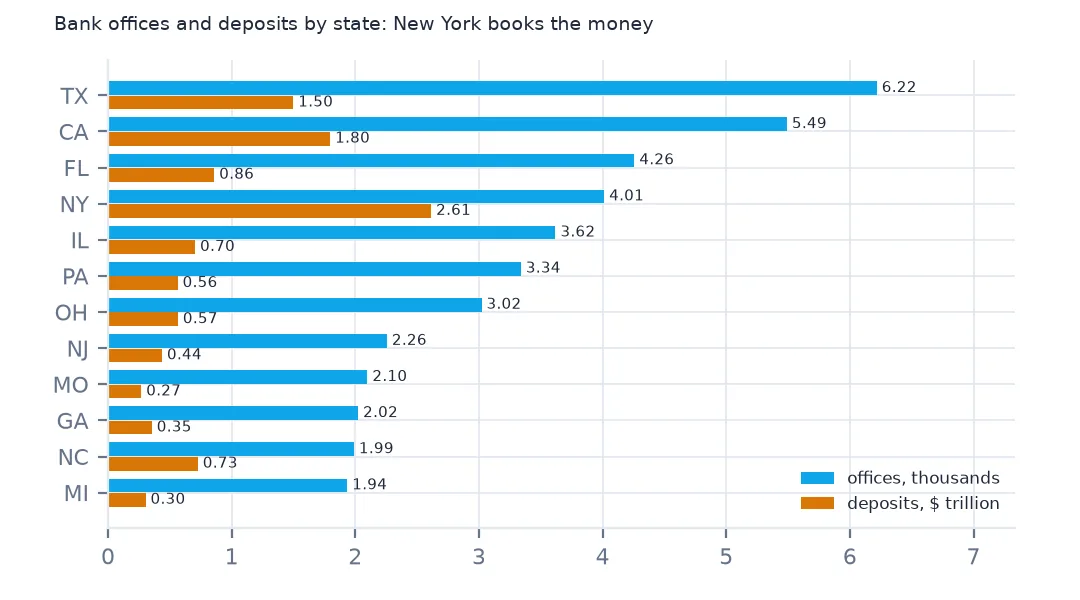
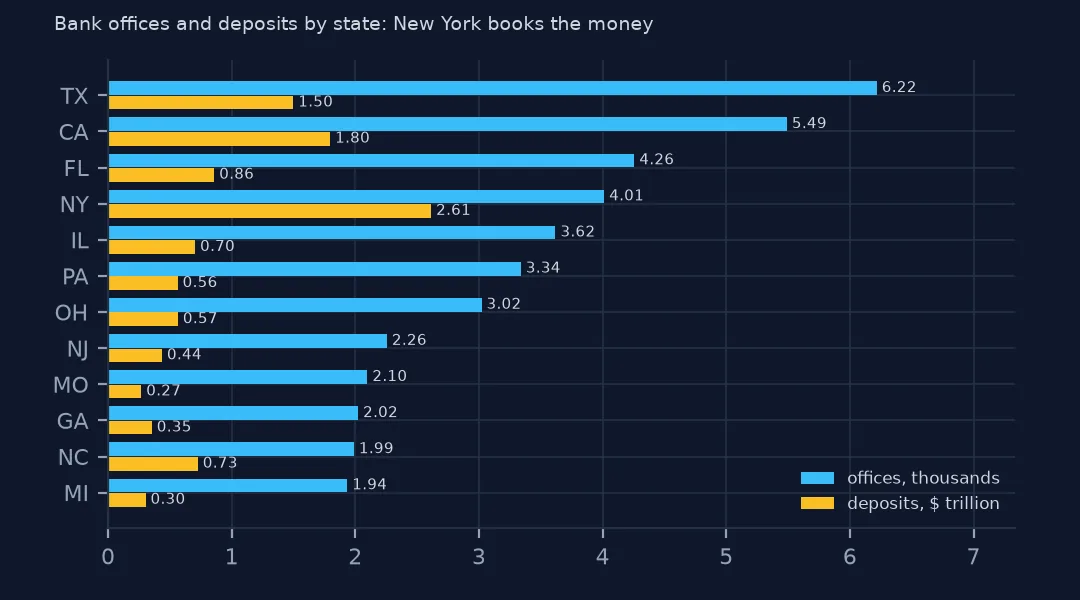
Texas has the most offices, 6,218, but New York the most deposits, $2,613.7 billion against Texas's $1,498.2 billion, because New York's counts include deposits booked at the head offices of national banks. California has $1,796.6 billion in 5,491 offices. Deposits by state measure where banks book money, not where depositors live.
Example 2: offices by type of institution
print(sod.groupby("SPECDESC").agg(offices=("UNINUMBR", "size"), institutions=("CERT", "nunique")).sort_values("offices", ascending=False).to_string()) offices institutions
SPECDESC
COMMERCIAL LENDING 47581 2465
ALL OTHER > $1 BILLION 14326 68
INTERNATIONAL 5736 5
AGRICULTURAL 4381 964
MORTGAGE LENDING 1631 323
ALL OTHER < $1 BILLION 1413 381
OTHER < $1 BILLION 590 179
CREDIT-CARD 281 10
CONSUMER LENDING 157 35
NO GROUP 1 1
The FDIC's specialisation groups show the shape of the industry. Commercial lenders are 2,465 institutions with 47,581 offices; 964 agricultural banks run 4,381 offices, mostly in the Plains and Midwest; and five "international" banks run 5,736, almost all of them JPMorgan Chase's and Citibank's. 68 large institutions in "all other > $1 billion" have 14,326 offices.
Internal links
- The Summary of Deposits explained — what an office and a deposit are here, and getting the data without code
- Branch service types — which offices are branches
- Deposits booked at head offices — the deposit column's biggest trap
- Branch coordinates — how good the points are