
How Many Bank Branches Are There? The FDIC Summary of Deposits Explained
On this page
Problem statement
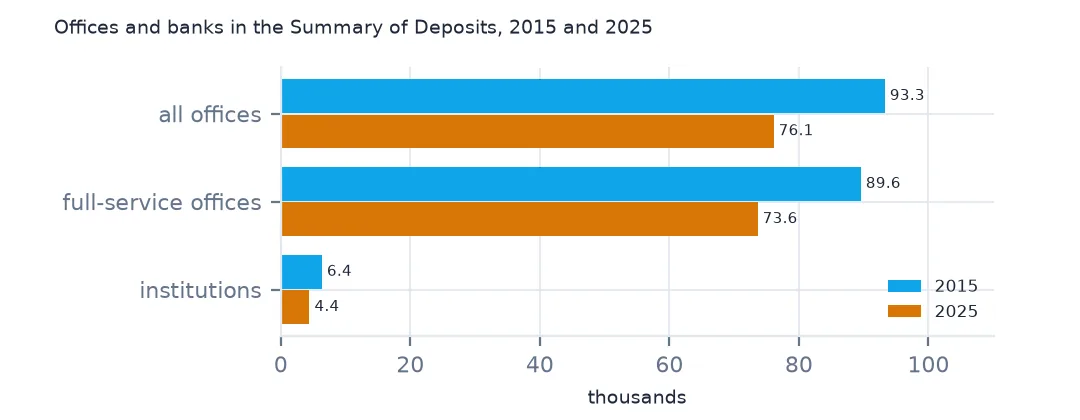
How many bank branches does the United States have? The FDIC's Summary of Deposits answers it every year, and the answer depends on what you call a branch. For 2025 it lists 76,097 offices, down from 93,272 in 2015, but the list includes drive-throughs, trust offices, administrative sites and internet "branches" alongside the familiar walk-in ones, and it leaves out credit unions, which the FDIC does not insure. This page shows what the survey counts as an office and as a deposit, who files it, and what one large bank's report looks like.
Quick answer
Compare the two years and count the offices that offer full service in person:
old = read_sod(2015)
print(f"2015: {len(old):,} offices of {old.CERT.nunique():,} institutions; 2025: {len(sod):,} offices of {sod.CERT.nunique():,}")
full = sod.BRSERTYP.isin([11, 12])
print(f"2025 full-service offices with walk-in service: {full.sum():,}")
2015: 93,272 offices of 6,358 institutions; 2025: 76,097 offices of 4,431
2025 full-service offices with walk-in service: 73,630
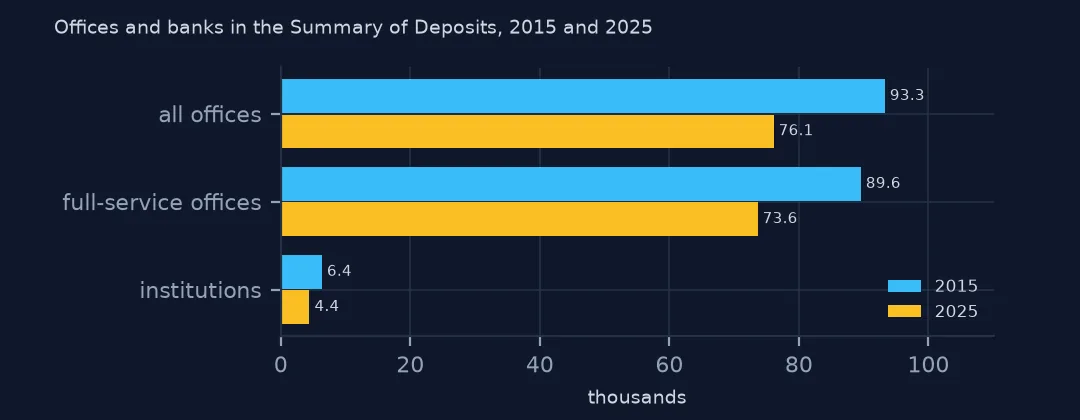
In 2025 the survey lists 76,097 offices of 4,431 institutions, against 93,272 offices of 6,358 institutions in 2015: almost a third fewer institutions, through mergers and failures, and 17,175 fewer offices. Counting only offices with full service in person, 73,630 remain, the best single answer to "how many bank branches".
Offices, deposits and filers
1. What an office is
TYPES = {11: "full service, brick and mortar", 12: "full service, retail", 13: "full service, home banking", 21: "limited, administrative",
         22: "limited, military facility", 23: "limited, drive-through or detached", 29: "limited, mobile or seasonal", 30: "limited, trust"}
print(sod.BRSERTYP.map(TYPES).value_counts().to_string())
BRSERTYP
full service, brick and mortar 71242
full service, retail 2388
limited, drive-through or detached 1449
limited, mobile or seasonal 357
limited, administrative 287
limited, trust 190
full service, home banking 182
limited, military facility 2
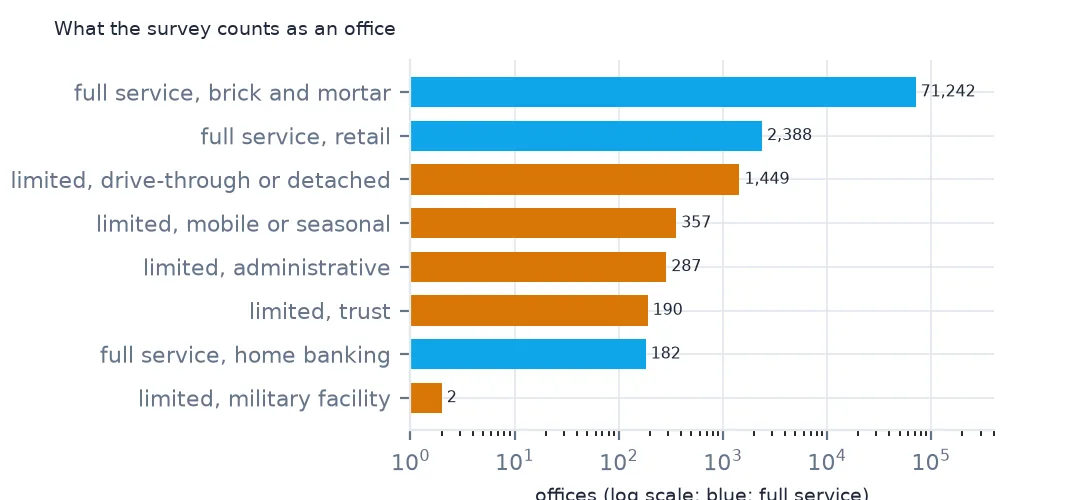
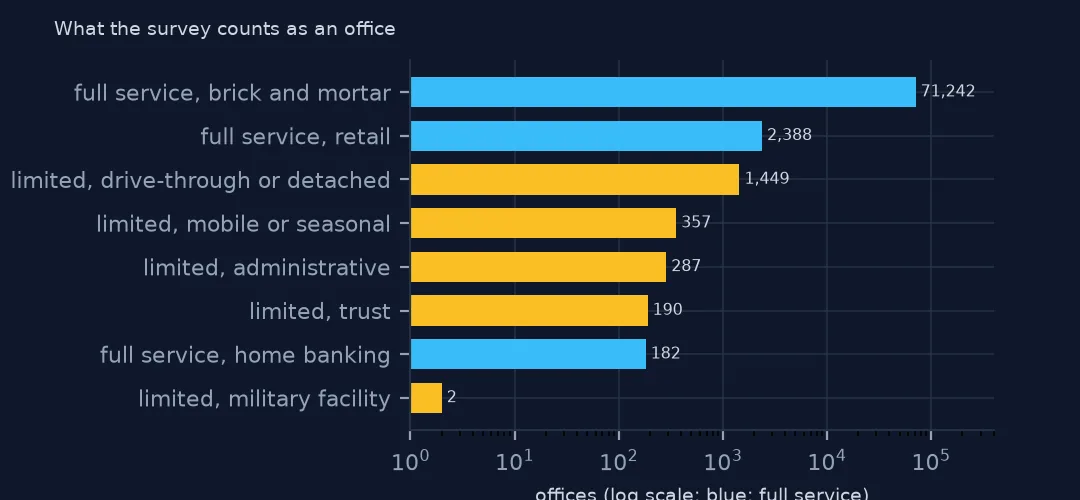
BRSERTYP classifies each office. 71,242 are full-service brick-and-mortar branches and 2,388 full-service retail offices, typically inside supermarkets. The rest are limited: 1,449 drive-throughs or detached facilities, 357 mobile or seasonal offices, 287 administrative offices, 190 trust offices and 2 on military bases, plus 182 full-service "home banking" offices, which are internet or phone banks registered as an office.
2. What a deposit is in this survey
main = sod[sod.BRNUM == 0]
print(f"deposits: ${sod.deposits.sum() / 1e12:.2f} trillion; held at main offices: {main.deposits.sum() / sod.deposits.sum():.1%}")
print(f"median branch: ${sod.deposits.median() / 1e6:.0f} million; median main office: ${main.deposits.median() / 1e6:.0f} million")
deposits: $18.10 trillion; held at main offices: 29.0%
median branch: $79 million; median main office: $138 million
A deposit here is where the bank books it, not where the customer lives. The offices hold $18.10 trillion, and 29.0% of it sits at main offices, which also take deposits gathered online, by phone and from corporate accounts. The median branch holds $79 million and the median main office $138 million, but the largest offices hold hundreds of billions. A deposit map needs the head-office fix.
3. Who files
print(sod.drop_duplicates("CERT").SPECDESC.value_counts().to_string())SPECDESC
COMMERCIAL LENDING 2465
AGRICULTURAL 964
ALL OTHER < $1 BILLION 381
MORTGAGE LENDING 323
OTHER < $1 BILLION 179
ALL OTHER > $1 BILLION 68
CONSUMER LENDING 35
CREDIT-CARD 10
INTERNATIONAL 5
NO GROUP 1
By the FDIC's specialisation, 2,465 institutions are commercial lenders and 964 agricultural banks, most of them small community banks; mortgage lenders are 323. Only 10 are credit-card banks and 5 international banks, but those few are among the largest by deposits.
One bank, every office
The data used on this page
The FDIC's Summary of Deposits for 2015 and 2025, every office of every FDIC-insured institution with its deposits as of 30 June, from the BankFind Suite API, downloaded on 28 October 2026 and saved on this site, because banks amend past reports and the API serves the revised figures. Public domain. Deposits are reported in thousands of dollars.
from pathlib import Path
import zipfile

import geopandas as gpd
import numpy as np
import pandas as pd
import requests

Path("data").mkdir(exist_ok=True)
# FDIC Summary of Deposits for 2015 and 2025 (every branch, deposits as of 30 June) from the BankFind Suite API, with
# the Census Bureau's 2024 county population estimates, 2020 tract centres of population, counties and states.
# Saved 28 October 2026: the API serves revised years as banks amend their reports.
# Live: https://api.fdic.gov/banks/sod?filters=YEAR:2025&limit=10000&offset=0
ARCHIVE = "fdic-sod-2026-10-28.zip"
if not Path(f"data/{ARCHIVE}").exists():
    Path(f"data/{ARCHIVE}").write_bytes(requests.get(f"https://data.spatialworkflow.io/{ARCHIVE}", timeout=600).content)
Z = zipfile.ZipFile(f"data/{ARCHIVE}")
for f in ["cb_2024_us_county_20m.zip", "cb_2024_us_state_20m.zip"]:
    Path(f"data/{f}").write_bytes(Z.read(f))
def read_sod(year):
    d = pd.read_csv(Z.open(f"fdic-sod-{year}.csv"), dtype={"ZIPBR": str})
    d["STCNTYBR"] = d.STCNTYBR.astype(str).str.zfill(5)          # county FIPS, stored as a number
    d["deposits"] = d.DEPSUMBR * 1000                              # reported in thousands of dollars
    return d
sod = read_sod(2025)
print(f"FDIC Summary of Deposits 2025: {len(sod):,} offices, ${sod.deposits.sum() / 1e12:,.2f} trillion in deposits")
FDIC Summary of Deposits 2025: 76,097 offices, $18.10 trillion in deposits
Example 1: one bank, every office
b = sod[sod.NAMEFULL.str.startswith("JPMorgan Chase Bank")]
print(f"{b.NAMEFULL.iloc[0]}: {len(b):,} offices in {b.STALPBR.nunique()} states; deposits ${b.deposits.sum() / 1e12:.2f} trillion")
print(b.nlargest(3, "deposits").assign(bn=lambda d: (d.deposits / 1e9).round(1))[["NAMEBR", "CITYBR", "STALPBR", "BRNUM", "bn"]].to_string(index=False))
JPMorgan Chase Bank, National Association: 5,001 offices in 49 states; deposits $2.13 trillion
NAMEBR CITYBR STALPBR BRNUM bn
Madison And 47Th St Branch New York NY 544 727.2
Houston Main Office Houston TX 1315 135.5
Chicago'S Main Office Branch Chicago IL 1838 43.1
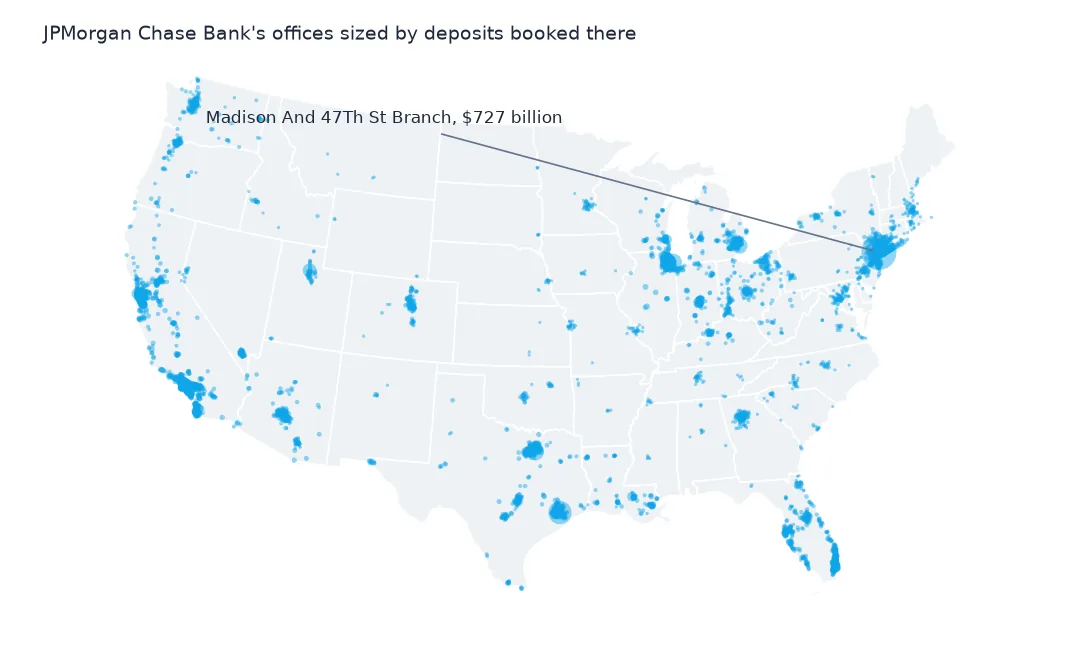
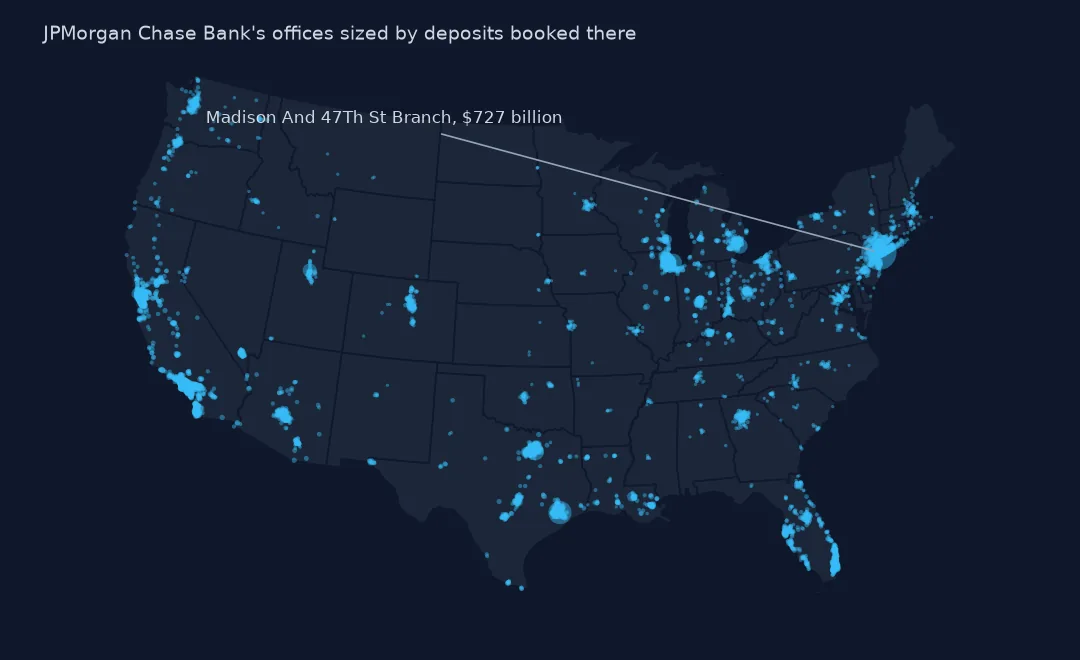
JPMorgan Chase Bank reports 5,001 offices in 49 states and $2.13 trillion of deposits. Its largest office by deposits is not a main office but a Manhattan branch, Madison and 47th Street, with $727.2 billion booked there; offices named as main offices in Houston and Chicago follow. One bank's report shows both sides of the survey: thousands of ordinary branches with tens of millions each, and a few offices where its national deposits are booked.
Getting the bank branch data without code
- Look first: the FDIC's BankFind Suite shows any bank's offices on a map, and its Summary of Deposits section has ready-made tables of deposits by state, county, metro area and institution for each survey year.
- Download: the same pages export to CSV, and the BankFind Suite API returns the whole survey for a year, 10,000 offices a request, without a key. A year's CSV opens in a spreadsheet; QGIS can map it with
SIMS_LONGITUDEandSIMS_LATITUDEas the X and Y fields. - What is included: every office of every FDIC-insured bank and savings institution, with the deposits it held on 30 June. Credit unions, which the National Credit Union Administration insures, are not in it.
- Units and codes: deposits are in thousands of dollars; county and ZIP codes lose their leading zeros if read as numbers;
BRSERTYPsays whether an office is full service or limited. - How current it is: the survey is taken each June and published in the autumn, and banks may amend past years, so a download can differ from an older one. These pages use 2015 and 2025, downloaded on 28 October 2026 and saved at data.spatialworkflow.io.
- Credit: Federal Deposit Insurance Corporation, Summary of Deposits, with the year. It is public domain.
Internal links
- Reading the survey — codes, units and points
- Branch service types — the office types in detail
- Branch closures since 2015 — where the 17,175 went
- The largest banks — branches and deposits by bank