
How to Rank US Banks by Branches and Deposits
On this page
Problem statement
Which are the biggest banks in the United States? It depends on the measure. By branches, the list is the national retail banks; by deposits, it includes Citibank and Capital One, which have far fewer branches, and the share held by the largest four depends on whether you count institutions or holding companies. The Summary of Deposits gives both measures for every FDIC-insured institution. This page ranks banks by offices and deposits, measures how concentrated the industry is, compares deposits per office and follows the largest networks since 2015.
Quick answer
Group the offices by institution and count offices, states and deposits:
banks = sod.groupby("NAMEFULL").agg(offices=("UNINUMBR", "size"), states=("STALPBR", "nunique"), deposits_bn=("deposits", lambda s: s.sum() / 1e9))
print(banks.sort_values("offices", ascending=False).head(8).round(0).astype(int).to_string())
print(f"institutions: {len(banks):,}; with one office: {(banks.offices == 1).sum():,}")
offices states deposits_bn
NAMEFULL
JPMorgan Chase Bank, National Association 5000 49 2133
Wells Fargo Bank, National Association 4213 40 1393
Bank of America, National Association 3640 39 1975
PNC Bank, National Association 2317 28 432
U.S. Bank National Association 2117 28 523
Truist Bank 1928 18 418
Regions Bank 1250 16 132
TD Bank, National Association 1103 16 293
institutions: 3,894; with one office: 677
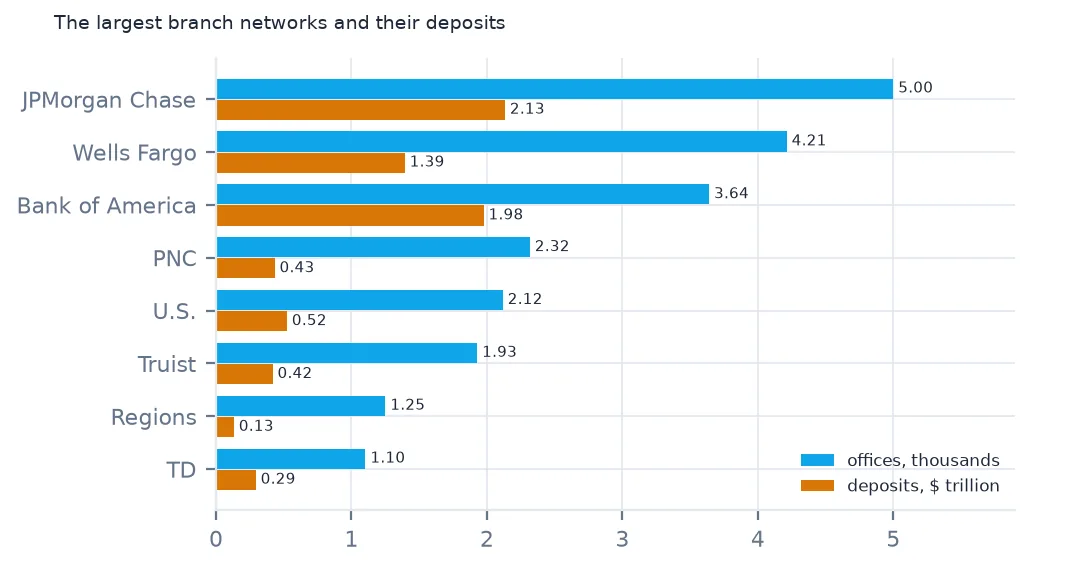
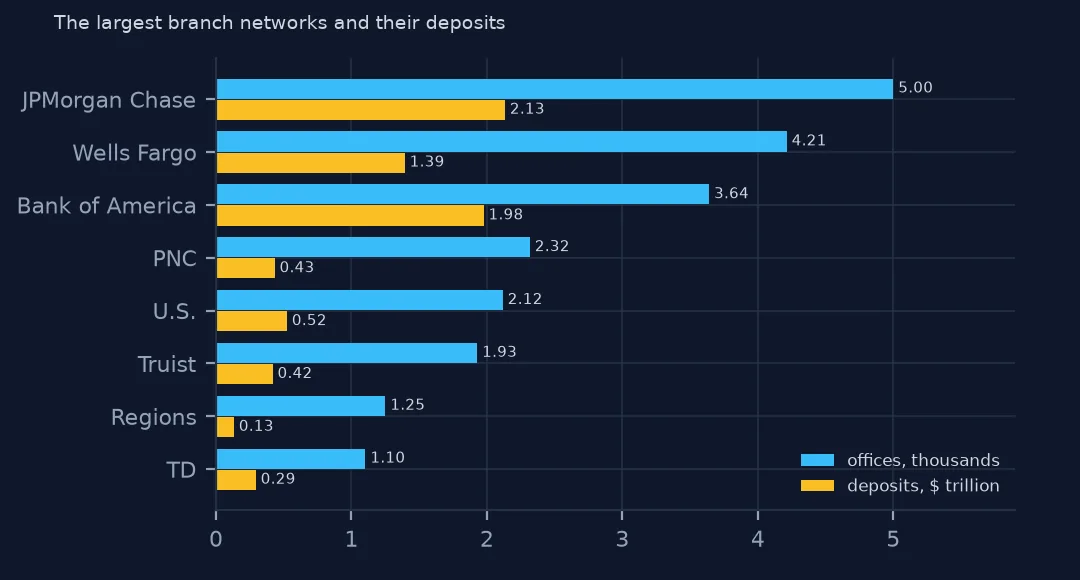
JPMorgan Chase has the most offices, 5,000 in 49 states, then Wells Fargo with 4,213 and Bank of America with 3,640. PNC, U.S. Bank and Truist follow with about 2,000 each. Below them the industry is a long tail: 3,894 institutions by name, 677 of them with a single office.
Deposits, intensity and change
1. By deposits
d = banks.deposits_bn.sort_values(ascending=False)
print(d.head(6).round(0).to_string())
print(f"largest 4 banks' share of deposits: {d.head(4).sum() / d.sum():.1%}; largest 10: {d.head(10).sum() / d.sum():.1%}")
NAMEFULL
JPMorgan Chase Bank, National Association 2133.0
Bank of America, National Association 1975.0
Wells Fargo Bank, National Association 1393.0
Citibank, National Association 795.0
U.S. Bank National Association 523.0
Capital One, National Association 497.0
largest 4 banks' share of deposits: 34.8%; largest 10: 48.9%
By deposits, JPMorgan Chase leads with $2,133 billion, Bank of America $1,975 billion and Wells Fargo $1,393 billion; Citibank is fourth with $795 billion from only 666 offices, and Capital One sixth. The four largest hold 34.8% of all deposits and the ten largest 48.9%.
2. Deposits per office
banks["per_office_m"] = banks.deposits_bn * 1000 / banks.offices
print(banks[banks.offices >= 500].sort_values("per_office_m", ascending=False).round(0).head(6).to_string())
offices states deposits_bn per_office_m
NAMEFULL
Citibank, National Association 666 14 795.0 1194.0
Bank of America, National Association 3640 39 1975.0 543.0
JPMorgan Chase Bank, National Association 5000 49 2133.0 427.0
Wells Fargo Bank, National Association 4213 40 1393.0 331.0
First-Citizens Bank & Trust Company 524 23 160.0 306.0
TD Bank, National Association 1103 16 293.0 266.0
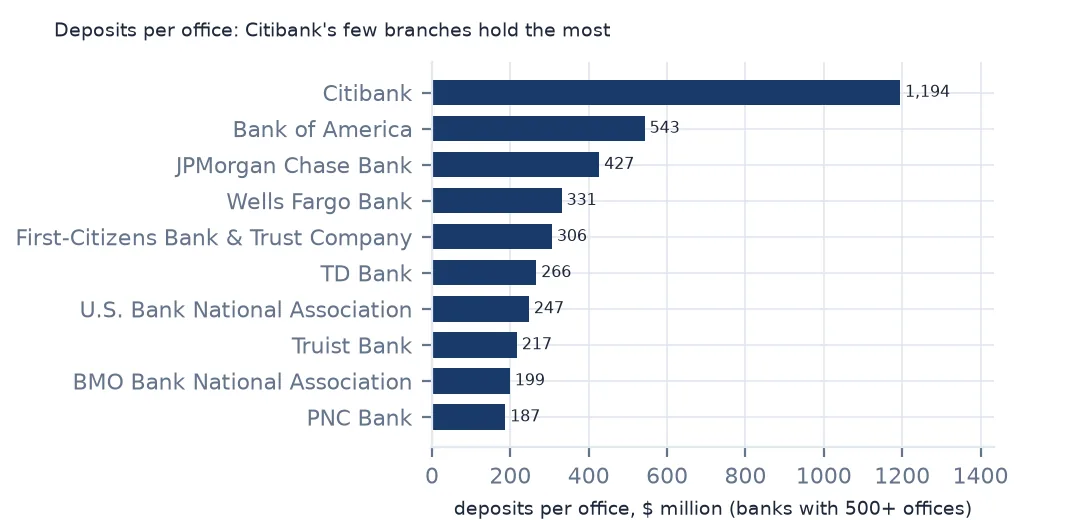
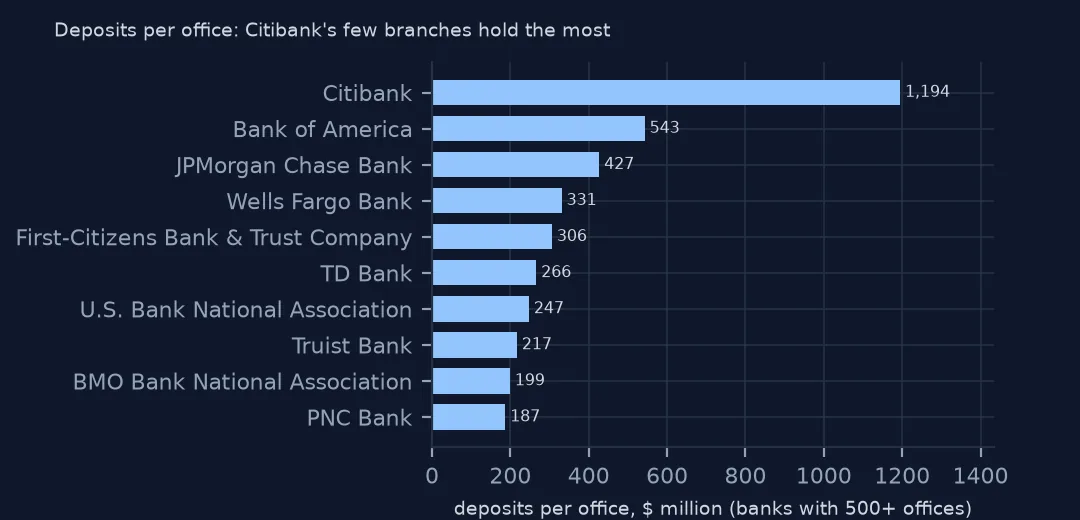
Among banks with at least 500 offices, Citibank holds $1,194 million per office, more than twice Bank of America's $543 million and nearly three times JPMorgan's $427 million. Citibank has largely left retail branch banking outside a few cities and books corporate and wealth deposits at its main offices. Deposits per office is a better guide to a bank's business than its size.
3. Ten years of change at the largest
old = read_sod(2015)
o = old.groupby("NAMEFULL").UNINUMBR.size()
t = pd.DataFrame({"2015": o, "2025": banks.offices}).loc[["JPMorgan Chase Bank, National Association", "Wells Fargo Bank, National Association", "Bank of America, National Association", "PNC Bank, National Association", "U.S. Bank National Association", "Truist Bank"]]
print(t.fillna(0).astype(int).to_string())
2015 2025
NAMEFULL
JPMorgan Chase Bank, National Association 5545 5000
Wells Fargo Bank, National Association 6232 4213
Bank of America, National Association 4861 3640
PNC Bank, National Association 2767 2317
U.S. Bank National Association 3221 2117
Truist Bank 0 1928
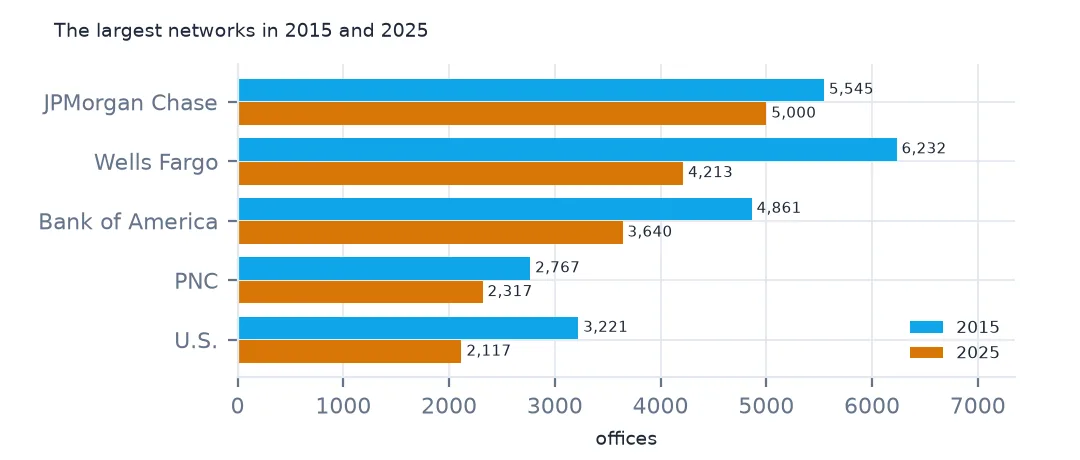
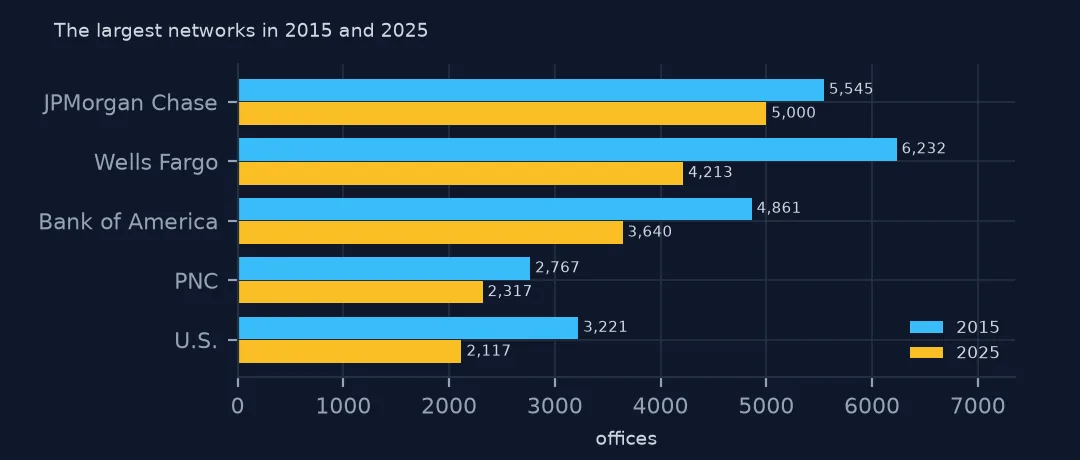
The three largest networks all shrank. Wells Fargo went from 6,232 offices in 2015 to 4,213, Bank of America from 4,861 to 3,640 and U.S. Bank from 3,221 to 2,117. JPMorgan closed the fewest in proportion, 5,545 to 5,000, while expanding into states where it had no branches. Truist has 0 offices in 2015 under that name: it is the former Branch Banking and Trust, renamed after its 2019 merger with SunTrust.
Community banks
The data used on this page
The FDIC's Summary of Deposits for 2015 and 2025, every office of every FDIC-insured institution with its deposits as of 30 June, from the BankFind Suite API, downloaded on 28 October 2026 and saved on this site, because banks amend past reports and the API serves the revised figures. Public domain. Deposits are reported in thousands of dollars.
from pathlib import Path
import zipfile

import geopandas as gpd
import numpy as np
import pandas as pd
import requests

Path("data").mkdir(exist_ok=True)
# FDIC Summary of Deposits for 2015 and 2025 (every branch, deposits as of 30 June) from the BankFind Suite API, with
# the Census Bureau's 2024 county population estimates, 2020 tract centres of population, counties and states.
# Saved 28 October 2026: the API serves revised years as banks amend their reports.
# Live: https://api.fdic.gov/banks/sod?filters=YEAR:2025&limit=10000&offset=0
ARCHIVE = "fdic-sod-2026-10-28.zip"
if not Path(f"data/{ARCHIVE}").exists():
    Path(f"data/{ARCHIVE}").write_bytes(requests.get(f"https://data.spatialworkflow.io/{ARCHIVE}", timeout=600).content)
Z = zipfile.ZipFile(f"data/{ARCHIVE}")
for f in ["cb_2024_us_county_20m.zip", "cb_2024_us_state_20m.zip"]:
    Path(f"data/{f}").write_bytes(Z.read(f))
def read_sod(year):
    d = pd.read_csv(Z.open(f"fdic-sod-{year}.csv"), dtype={"ZIPBR": str})
    d["STCNTYBR"] = d.STCNTYBR.astype(str).str.zfill(5)          # county FIPS, stored as a number
    d["deposits"] = d.DEPSUMBR * 1000                              # reported in thousands of dollars
    return d
sod = read_sod(2025)
print(f"FDIC Summary of Deposits 2025: {len(sod):,} offices, ${sod.deposits.sum() / 1e12:,.2f} trillion in deposits")
FDIC Summary of Deposits 2025: 76,097 offices, $18.10 trillion in deposits
Example 1: community banks
cb = sod.groupby("CERT").agg(dep=("deposits", "sum"), offices=("UNINUMBR", "size"))
small = cb[cb.dep < 1e9]
print(f"institutions under $1 billion in deposits: {len(small):,} of {len(cb):,}; their offices: {small.offices.sum():,} ({small.offices.sum() / cb.offices.sum():.1%}); their deposits: {small.dep.sum() / cb.dep.sum():.1%}")
institutions under $1 billion in deposits: 3,516 of 4,431; their offices: 15,638 (20.6%); their deposits: 5.8%
3,516 of the 4,431 institutions have less than $1 billion in deposits. Together they run 15,638 offices, 20.6% of all, but hold only 5.8% of deposits. Community banks are most of the banks and a fifth of the branches, and they are the branches in many small towns.
Internal links
- Deposit market share by county — concentration in local markets
- Branch closures since 2015 — the closures behind the falling counts
- Deposits booked at head offices — where the largest banks book deposits
- The Summary of Deposits explained — the survey, and getting the data without code