
Why Are My Station Wind Speeds Ten Times Too High?
On this page
Problem statement
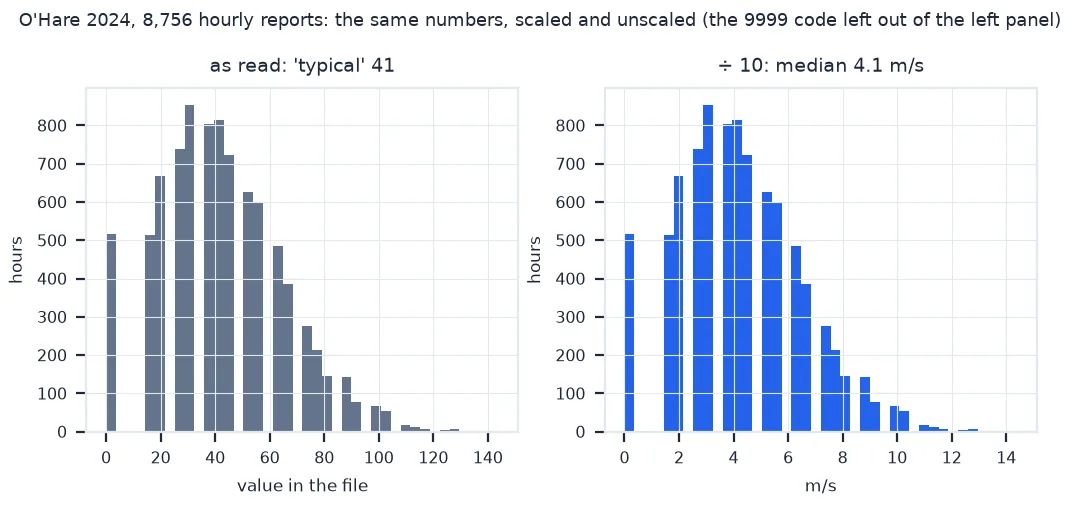
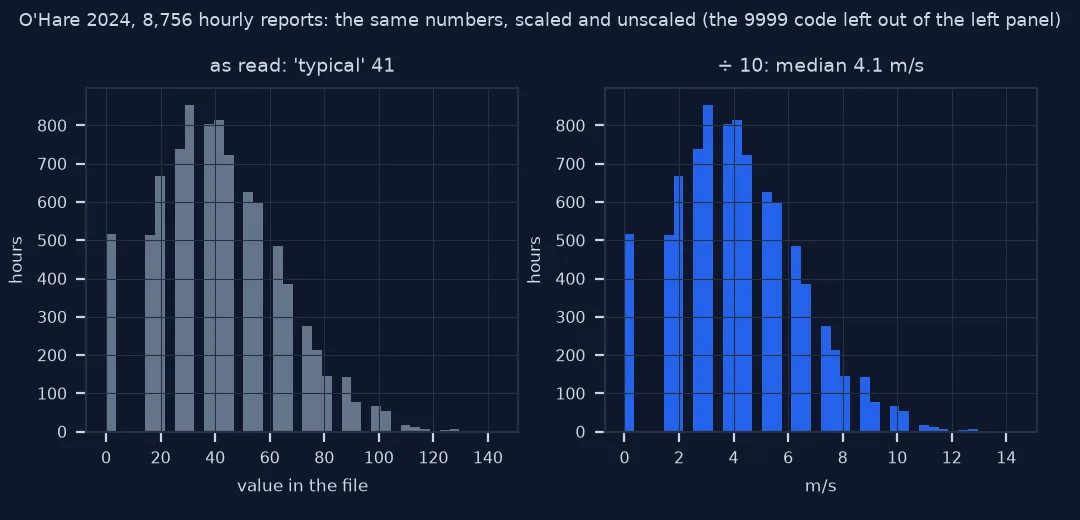
You read wind speeds from NOAA's Integrated Surface Database, plot them, and Chicago's typical wind is 41 metres per second, a hurricane every day, with a maximum of 9,999. Nothing is wrong with the stations. ISD stores wind speed as an integer in tenths of a metre per second, packed into a text field with its direction and quality codes, and marks missing values with 9999. Read the number as it is and every speed is ten times too high; leave the missing code in and the maximum is 999.9.
This page decodes a year of hourly wind reports from Chicago O'Hare in 2024 three ways, shows what each mistake does to the statistics, and checks the decoded speeds against ISD-Lite, a simplified version of the same data.
Quick answer
Split the WND field, divide the speed by ten, and mask the missing codes:
w = ALL.WND.str.split(",", expand=True)
w.columns = ["dir", "dir_q", "type", "speed", "speed_q"]
raw_number = pd.to_numeric(w.speed)
speed = pd.to_numeric(w.speed.replace("9999", np.nan)) / 10           # tenths of m/s; 9999 = missing
for label, x in (("as read", raw_number), ("÷ 10, missing kept", raw_number / 10), ("÷ 10, missing masked", speed)):
    print(f"{label:>22}: mean {x.mean():6.1f}, median {x.median():5.1f}, max {x.max():6.1f}")
as read: mean 43.5, median 41.0, max 9999.0
÷ 10, missing kept: mean 4.4, median 4.1, max 999.9
÷ 10, missing masked: mean 4.2, median 4.1, max 14.4
Read the field as text, use quality codes, check ISD-Lite
1. Read the field as text
WND looks like 250,5,N,0046,5: direction in degrees, a quality code, a type code (N normal, C calm, V variable, 9 missing), speed in tenths of m/s with leading zeros, and a quality code. Read it as text, or the leading zeros and the commas will confuse pandas:
print(ALL.WND.head(3).tolist())
print(w.type.value_counts().rename({"N": "normal", "C": "calm", "V": "variable", "9": "missing"}).to_string())
['310,5,N,0057,5', '320,5,N,0072,5', '320,5,N,0072,5']
type
normal 8079
calm 517
variable 160
2. Use the quality codes
The quality codes say whether a value passed NOAA's checks. Codes 1 and 5 mean passed; 2 and 6 suspect; 3 and 7 erroneous; 9 missing:
print(w.speed_q.value_counts().to_string())
bad = w.speed_q.isin(["2", "3", "6", "7"])
print(f"speeds flagged suspect or erroneous: {bad.sum()}")
speed_q
5 8026
1 729
9 1
speeds flagged suspect or erroneous: 0
3. Check against ISD-Lite
ISD-Lite is a simplified hourly extract of the same database, one line per hour with speed also in tenths of m/s and missing as -9999. The two decoded series should agree for the same hours:
lite = LITE.set_index("time").speed
both = pd.DataFrame({"isd": speed.groupby(ALL.time.dt.round("h").values).first(), "lite": lite}).dropna()   # :51 reports belong to the next hour
print(f"{len(both):,} hours in both; identical speed in {(both.isd == both.lite).mean():.1%}; "
      f"mean {both.isd.mean():.2f} against {both.lite.mean():.2f} m/s")
8,750 hours in both; identical speed in 99.2%; mean 4.24 against 4.24 m/s
The hour each report belongs to matters as much as the scale. Routine reports are taken at 51 minutes past; rounding to the nearest hour matches ISD-Lite in 99.2% of hours, while truncating to the hour shifts every report back by one and matches only 20.7%.
Knots and miles per hour
The data used on this page
NOAA's Integrated Surface Database, Global Hourly access file for Chicago O'Hare (station 725300-94846) for 2024, routine hourly reports (FM-15) only, and the ISD-Lite file for the same station and year.
import gzip
from pathlib import Path

import numpy as np
import pandas as pd
import requests

Path("data").mkdir(exist_ok=True)
SRC = {"72530094846.csv": "https://noaa-global-hourly-pds.s3.amazonaws.com/2024/72530094846.csv",
       "725300-94846-2024.gz": "https://www.ncei.noaa.gov/pub/data/noaa/isd-lite/2024/725300-94846-2024.gz"}
for name, url in SRC.items():
    if not Path("data", name).exists():
        Path("data", name).write_bytes(requests.get(url, timeout=300).content)
ALL = pd.read_csv("data/72530094846.csv", usecols=["DATE", "REPORT_TYPE", "WND"], dtype=str)
ALL = ALL[ALL.REPORT_TYPE.str.strip() == "FM-15"].copy()
ALL["time"] = pd.to_datetime(ALL.DATE)
lite = pd.read_fwf(gzip.open("data/725300-94846-2024.gz", "rt"), widths=[4, 3, 3, 3, 6, 6, 6, 6, 6, 6, 6, 6], header=None,
                   names=["y", "m", "d", "h", "t", "td", "slp", "wd", "ws", "sky", "p1", "p6"])
LITE = pd.DataFrame({"time": pd.to_datetime(dict(year=lite.y, month=lite.m, day=lite.d, hour=lite.h)),
                     "speed": lite.ws.where(lite.ws != -9999) / 10})
print(f"{len(ALL):,} routine hourly reports; {len(LITE):,} ISD-Lite hours")
8,756 routine hourly reports; 8,766 ISD-Lite hours
Example 1: knots and miles per hour
Once in metres per second, convert for the audience:
s = speed.dropna()
print(f"median {s.median():.1f} m/s = {s.median() * 1.94384:.1f} kt = {s.median() * 2.23694:.1f} mph; "
      f"strongest {s.max():.1f} m/s = {s.max() * 1.94384:.0f} kt")
kt = s[s > 0] * 1.94384
print(f"non-calm speeds within 0.15 kt of a whole number of knots: {(np.abs(kt - kt.round()) < 0.15).mean():.0%}; "
      f"distinct speed values: {s.nunique()}")
median 4.1 m/s = 8.0 kt = 9.2 mph; strongest 14.4 m/s = 28 kt
non-calm speeds within 0.15 kt of a whole number of knots: 100%; distinct speed values: 27
Every speed is a whole number of knots converted to metres per second: US airports report in knots, and the year's speeds take only 27 different values. Differences of a tenth of a metre per second are rounding in the conversion, not measurements.
Scaled integers in a fixed-width archive
ISD stores most measurements as scaled integers: temperature in tenths of a degree, pressure in tenths of a hectopascal, wind in tenths of a metre per second. Integers keep the fixed-width archive compact and avoid ambiguity about decimal separators, and every value has a documented missing code made of nines that cannot be confused with a real value of the same width. The CSV access files keep the packed fields as they are, so the scaling is the reader's job.
The scale factor is easy to miss because the result can look plausible in one context: 46, the code for 4.6 m/s, is also a believable number of knots or kilometres per hour. The missing code is easy to miss because it is rare: here one hour in the year, which barely moves a mean but sets the maximum.
Calm, gusts and special reports
- Calm: calm hours have type
Cand speed 0; keep them as 0 m/s, not missing. - Gusts: gusts are in the separate
OC1field, also in tenths of m/s. - Other fields:
TMPandDEWare in tenths of a degree with+9999missing;SLPin tenths of hPa with99999missing. - ISD-Lite: speeds in tenths of m/s, missing as
-9999, one record per hour. - Special reports:
FM-16specials repeat some hours; keepFM-15for hourly statistics.
Internal links
- How to make a wind rose in Python — decoded ISD winds in use
- How to check model winds against station observations — ISD-Lite for many stations
FAQ
What units are ISD wind speeds in?
Tenths of a metre per second: divide by ten for m/s.
What does 9999 mean in NOAA ISD wind data?
A missing speed; 999 is a missing direction. Mask them before computing anything.
How do I parse the ISD WND field in Python?
Split on commas into direction, direction quality, type, speed and speed quality, read as text, then convert the speed and divide by ten.
Why does my maximum wind speed show 999.9?
The missing code 9999 was divided by ten but not masked.