
How Long Does a Superfund Cleanup Take? From Listing to Deletion
On this page
Problem statement
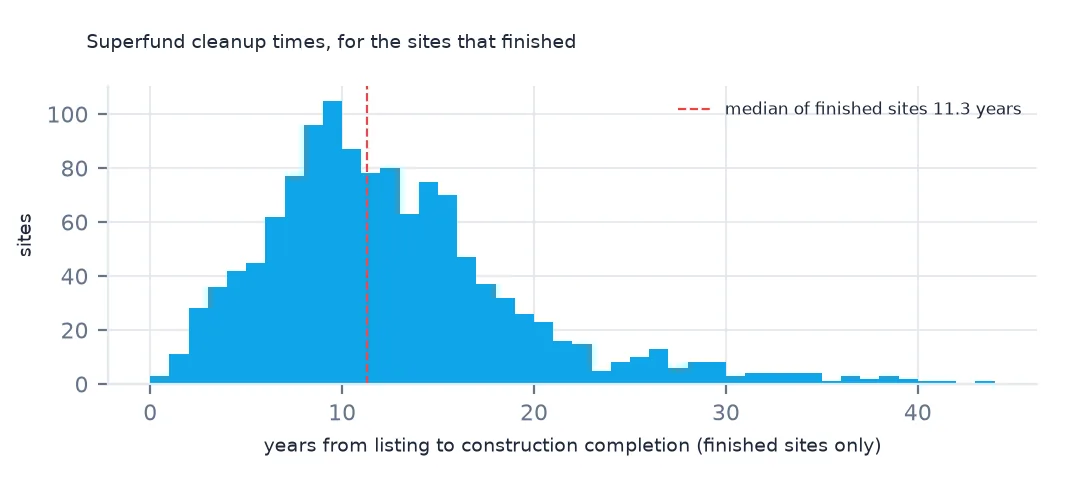
How long does a Superfund cleanup take? The quick answer from EPA's data, a median of 11.3 years from listing to construction completion, is the median of the sites that have finished, and it leaves out the 553 that have not. Durations measured only on finished cases are biased short, because the slowest cases are still running: the same problem as estimating a hospital stay from discharged patients. This page computes the times from the National Priorities List's milestone dates, then looks at the unfinished sites and at each decade's sites separately, to show how long cleanups really take.
Quick answer
Subtract the listing date from the construction completion and deletion dates:
listed = npl[npl.Listing_Date.notna()].copy()
listed["to_complete"] = (listed.Construction_Completion_Date - listed.Listing_Date).dt.days / 365.25
listed["to_delete"] = (listed.Deletion_Date - listed.Listing_Date).dt.days / 365.25
print(f"listed sites: {len(listed):,}; construction complete: {listed.to_complete.notna().sum():,}; deleted: {listed.to_delete.notna().sum():,}")
print(listed[["to_complete", "to_delete"]].describe().round(1).loc[["count", "50%", "max"]].to_string())
listed sites: 1,798; construction complete: 1,245; deleted: 462
to_complete to_delete
count 1245.0 462.0
50% 11.3 13.5
max 43.0 42.9
Of 1,798 listed sites, 1,245 have reached construction completion after listing, a median of 11.3 years later, and 462 have been deleted, a median of 13.5 years after listing. The longest finished cleanup took 43.0 years. The few sites that completed or were deleted before their final listing are left out by the subtraction.
Unfinished sites, decades and the median
1. The sites that are not finished
now = pd.Timestamp("2026-10-28")
open_ = listed[listed.Construction_Completion_Date.isna()]
print(f"listed, not construction complete: {len(open_)}; median years on the list so far: {((now - open_.Listing_Date).dt.days / 365.25).median():.1f}")
print(open_.groupby(open_.Listing_Date.dt.year // 10 * 10).size().to_string())
listed, not construction complete: 553; median years on the list so far: 25.1
Listing_Date
1980 139
1990 109
2000 127
2010 134
2020 44
553 listed sites have not reached construction completion, and their median time on the list so far is 25.1 years. 139 of them were listed in the 1980s and 109 in the 1990s. These are the hardest sites, and each will, when it finishes, have taken longer than the time it has already spent on the list.
2. Time by the decade listed
listed["decade"] = listed.Listing_Date.dt.year // 10 * 10
listed["done_10y"] = listed.to_complete <= 10
print(listed[listed.decade <= 2010].groupby("decade").agg(sites=("Site_Name", "size"), complete_within_10y=("done_10y", "mean"), complete_ever=("to_complete", lambda s: s.notna().mean())).round(3).to_string())
sites complete_within_10y complete_ever
decade
1980 1033 0.297 0.865
1990 383 0.381 0.715
2000 189 0.212 0.328
2010 149 0.081 0.101
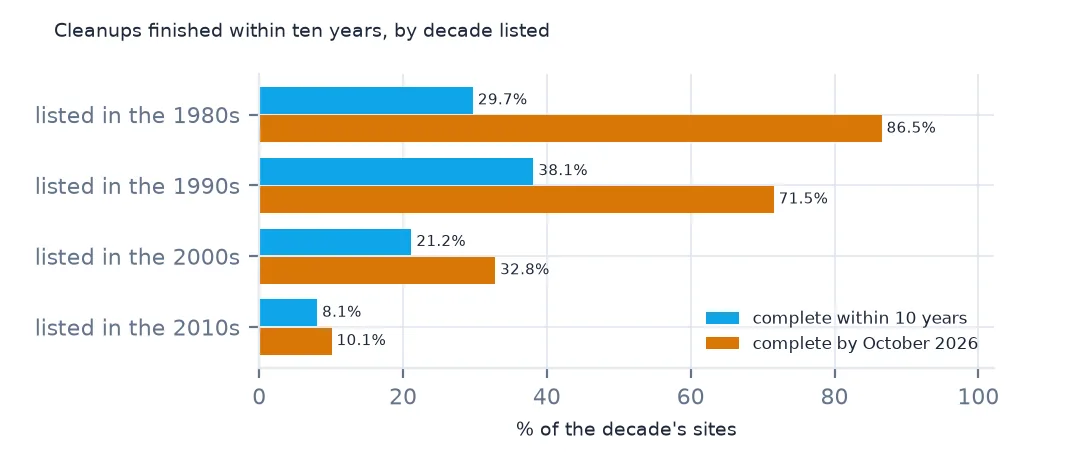
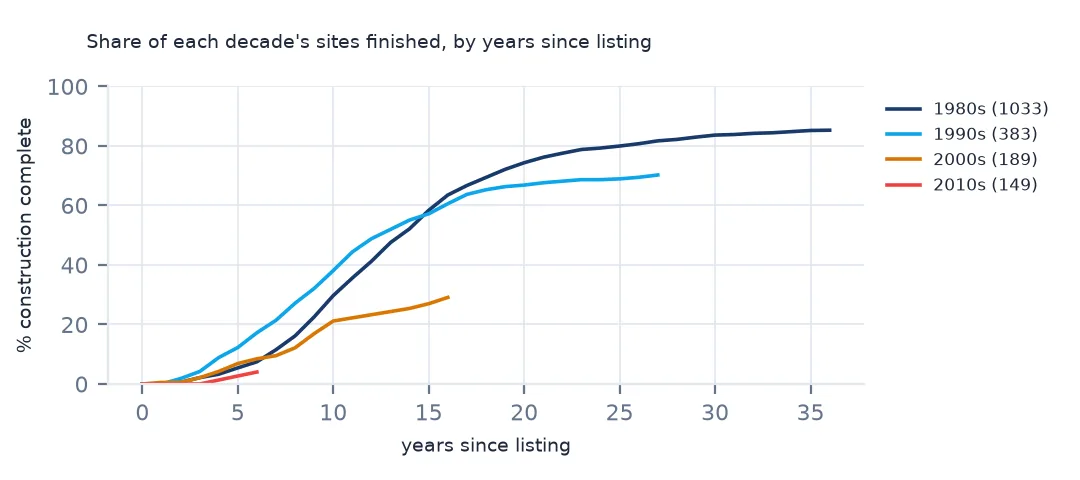
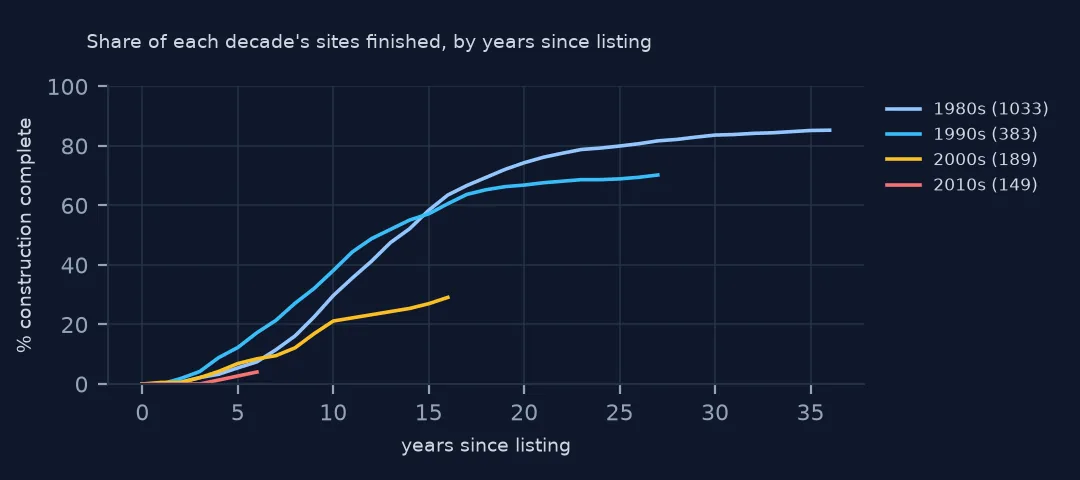
Split by decade of listing, 29.7% of the 1980s sites reached construction completion within 10 years, 38.1% of the 1990s', 21.2% of the 2000s' and only 8.1% of the 2010s'. 86.5% of the 1980s sites have finished by now, but only 32.8% of the 2000s' and 10.1% of the 2010s'. Recent sites are not yet old enough to finish; the 10-year share is the fairer comparison, and it has fallen.
3. Why the median of finished sites misleads
for d in [1980, 1990, 2000]:
    g = listed[listed.decade == d]
    print(d, f"median of finished: {g.to_complete.median():.1f} years; finished so far: {g.to_complete.notna().mean():.1%}")
1980 median of finished: 12.1 years; finished so far: 86.5%
1990 median of finished: 9.5 years; finished so far: 71.5%
2000 median of finished: 8.8 years; finished so far: 32.8%
The median of finished sites falls from 12.1 years for the 1980s sites to 9.5 for the 1990s' and 8.8 for the 2000s', which looks like cleanups getting faster. It is the opposite. Only a third of the 2000s sites have finished, the quick ones; the slow two thirds are still open. Use survival methods, such as a Kaplan-Meier curve, or compare shares finished within a fixed time, never the median of the finished.
The slowest finished cleanups
The data used on this page
The US Environmental Protection Agency's Superfund National Priorities List (NPL) Sites with Status Information and its national Superfund site boundaries, every record of both ArcGIS layers, downloaded on 28 October 2026 and saved on this site, because EPA edits both as sites are proposed, listed, completed and deleted. Public domain. The contact names, telephone numbers and e-mail addresses of EPA staff in the boundary layer were left out of the copy.
from pathlib import Path
import zipfile

import geopandas as gpd
import numpy as np
import pandas as pd
import requests

Path("data").mkdir(exist_ok=True)
# EPA's Superfund National Priorities List with status information and EPA's Superfund site boundaries, with the
# Census Bureau's 2020 tract centres of population, 2024 county estimates, counties and states. Saved 28 October 2026:
# EPA updates both layers as sites are proposed, listed, completed and deleted.
# Live: https://services.arcgis.com/cJ9YHowT8TU7DUyn/arcgis/rest/services/Superfund_National_Priorities_List_(NPL)_Sites_with_Status_Information/FeatureServer/0
ARCHIVE = "epa-superfund-npl-2026-10-28.zip"
if not Path(f"data/{ARCHIVE}").exists():
    Path(f"data/{ARCHIVE}").write_bytes(requests.get(f"https://data.spatialworkflow.io/{ARCHIVE}", timeout=600).content)
Z = zipfile.ZipFile(f"data/{ARCHIVE}")
for f in ["npl-sites-status.geojson", "npl-site-boundaries.geojson", "cb_2024_us_county_20m.zip", "cb_2024_us_state_20m.zip"]:
    if not Path(f"data/{f}").exists():
        Path(f"data/{f}").write_bytes(Z.read(f))
npl = gpd.read_file("data/npl-sites-status.geojson")
npl = gpd.GeoDataFrame(npl.drop(columns="geometry"), geometry=gpd.points_from_xy(npl.Longitude, npl.Latitude), crs=4326)
DATES = ["Proposed_Date", "Listing_Date", "Construction_Completion_Date", "NOID_Date", "Deletion_Date"]
npl[DATES] = npl[DATES].apply(pd.to_datetime, format="%m/%d/%Y")        # stored as MM/DD/YYYY text
print(f"Superfund National Priorities List: {len(npl):,} sites, {npl.Status.value_counts().to_dict()}")
Superfund National Priorities List: 1,840 sites, {'NPL Site': 1337, 'Deleted NPL Site': 466, 'Proposed NPL Site': 37}
Example 1: the slowest finished cleanups
print(listed.nlargest(5, "to_complete")[["Site_Name", "State", "Listing_Date", "Construction_Completion_Date", "to_complete"]].round(1).to_string(index=False)) Site_Name State Listing_Date Construction_Completion_Date to_complete
Fair Lawn Well Field New Jersey 1983-09-08 2026-09-23 43.0
Scientific Chemical Processing New Jersey 1983-09-08 2025-08-06 41.9
Evor Phillips Leasing New Jersey 1983-09-08 2024-04-24 40.6
Imperial Oil Co., Inc./Champion Chemicals New Jersey 1983-09-08 2023-06-26 39.8
William Dick Lagoons Pennsylvania 1987-07-22 2026-09-15 39.2
The slowest finished cleanups are all old New Jersey and Pennsylvania sites. Fair Lawn Well Field, listed in September 1983, reached construction completion in September 2026, 43.0 years later; Scientific Chemical Processing and Evor Phillips Leasing, from the same first list, took 41.9 and 40.6 years.
Internal links
- The National Priorities List explained — the milestones, and getting the data without code
- Hazard Ranking System scores — whether a higher score means a faster cleanup
- Federal facilities — the slowest group of sites
- Reading the list — parsing the dates