
Fixing SST Values That Read as Thousands Instead of Degrees
On this page
Problem statement
Sea surface temperatures read from a NetCDF file come out as 2,680 instead of 26.8 °C, land cells are -999 instead of missing, and a mean over the ocean is negative. The file is not corrupt. Many products, including NOAA's daily OISST files from NCEI, store temperatures as 16-bit integers with a scale_factor of 0.01 and a _FillValue of -999, which halves the file size, and rely on the reader to unpack them. xarray and netCDF4 do that by default; reading with the unpacking turned off, with h5py, or with a tool that ignores the attributes does not.
This page reads one OISST file packed and unpacked, decodes the integers by hand, shows the precision packing costs, and writes a packed file back correctly.
Quick answer
Let the library apply scale_factor, add_offset and _FillValue, or apply them yourself:
raw = xr.open_dataset(P, mask_and_scale=False).sst.squeeze(drop=True)
dec = xr.open_dataset(P).sst.squeeze(drop=True)
a = raw.attrs
print(f"stored: {raw.dtype}, scale_factor {a['scale_factor']}, add_offset {a['add_offset']}, _FillValue {a['_FillValue']}")
v = raw.sel(lat=0.125, lon=180.125)
print(f"one cell: stored {int(v)}, decoded {float(dec.sel(lat=0.125, lon=180.125)):.2f} °C, by hand {int(v) * a['scale_factor'] + a['add_offset']:.2f} °C")
stored: int16, scale_factor 0.009999999776482582, add_offset 0.0, _FillValue -999
one cell: stored 2972, decoded 29.72 °C, by hand 29.72 °C
Temperatures are stored as 16-bit integers. The scale factor reads as 0.009999999776482582, the nearest 32-bit float to 0.01. A cell on the equator stores 2972, which decodes to 29.72 °C, the same by hand as by xarray.
Undecoded means, decoding by hand, kept precision
1. What an undecoded mean looks like
Average the stored integers and the decoded values over the whole grid:
print(f"stored integers: mean {float(raw.mean()):,.1f}, min {int(raw.min())}, max {int(raw.max())}")
print(f"decoded: mean {float(dec.mean()):.2f} °C, min {float(dec.min()):.2f}, max {float(dec.max()):.2f} °C; missing {int(dec.isnull().sum()):,} cells")
print(f"cells equal to the fill value -999: {int((raw == a['_FillValue']).sum()):,}")
stored integers: mean 603.3, min -999, max 3378
decoded: mean 14.05 °C, min -1.80, max 33.78 °C; missing 345,650 cells
cells equal to the fill value -999: 345,650
Averaged as stored, the grid's mean is 603.3 and its minimum -999. Decoded, the mean is 14.05 °C, from -1.80 °C under sea ice to 33.78 °C, and the 345,650 cells holding the fill value are missing.
2. Decode by hand
Some readers return only the integers. Mask the fill value first, then scale; scaling first turns -999 into -9.99 °C, a plausible-looking temperature:
wrong = raw * a["scale_factor"] + a["add_offset"]
right = raw.where(raw != a["_FillValue"]) * a["scale_factor"] + a["add_offset"]
print(f"scale only: min {float(wrong.min()):.2f} °C, mean {float(wrong.mean()):.2f} °C")
print(f"mask, then scale: min {float(right.min()):.2f} °C, mean {float(right.mean()):.2f} °C; equal to xarray's decoding: {bool(np.allclose(right, dec, equal_nan=True))}")
scale only: min -9.99 °C, mean 6.03 °C
mask, then scale: min -1.80 °C, mean 14.05 °C; equal to xarray's decoding: True
Scaling without masking turns every land cell into -9.99 °C, which drags the mean down to 6.03 °C and looks like cold water, not missing data. Masking first gives exactly xarray's decoding.
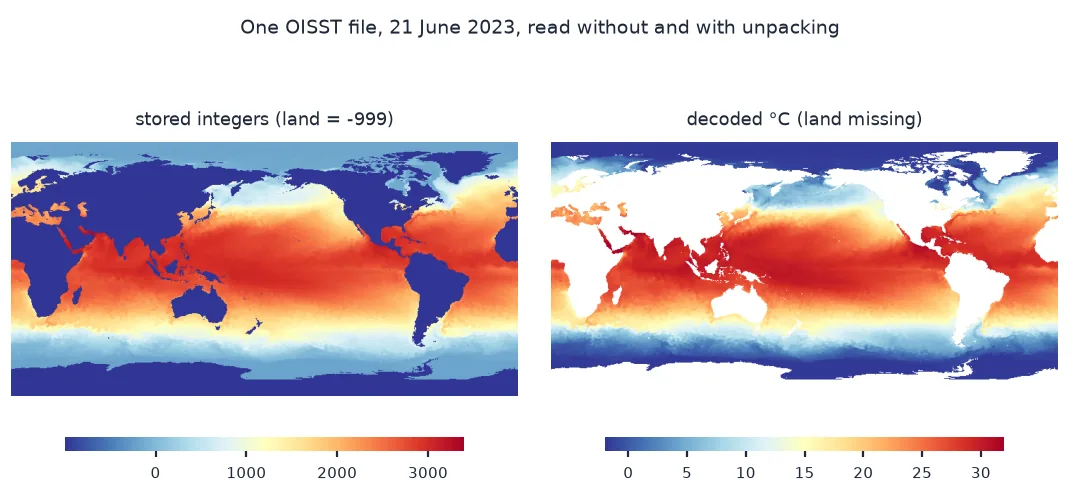
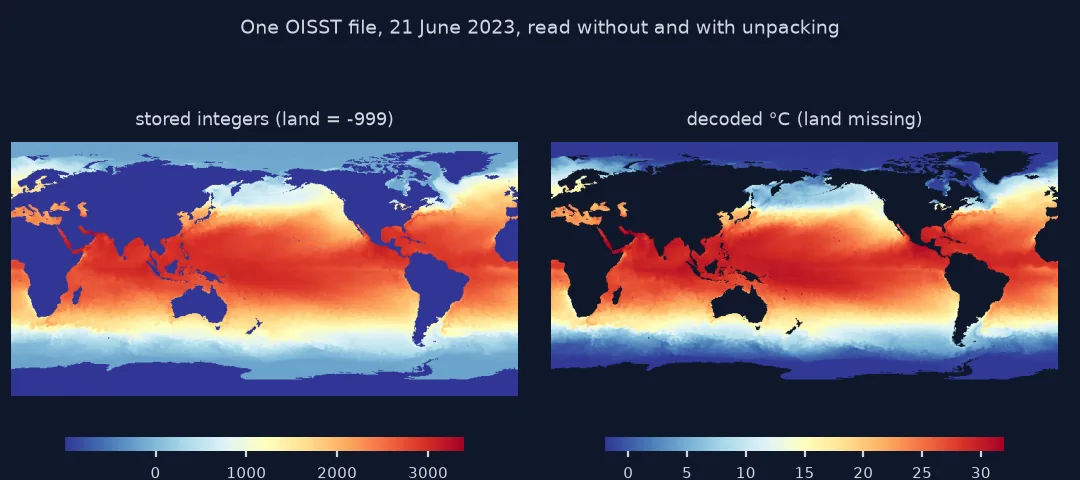
3. The precision packing keeps
With a scale factor of 0.01, every value should be a whole number of hundredths of a degree. Check, and note that the stored scale factor is a 32-bit float:
hund = (dec * 100).round(6)
print(f"values that are whole hundredths: {float((hund == hund.round()).sum() / hund.notnull().sum()):.0%}")
print(f"distinct values in the grid: {np.unique(dec.values[~np.isnan(dec.values)]).size:,}; valid range {a['valid_min'] * a['scale_factor']:.2f} to {a['valid_max'] * a['scale_factor']:.2f} °C")
values that are whole hundredths: 67%
distinct values in the grid: 3,510; valid range -3.00 to 45.00 °C
Only 67% of decoded values are exact hundredths in floating point, because the scale factor itself is not exactly 0.01; the 3,510 distinct values are the hundredths between the coldest and warmest cells. The packing's valid range is -3.00 to 45.00 °C.
Writing a packed file and reading it back
The data used on this page
The NOAA OISST v2.1 daily file for 21 June 2023, oisst-avhrr-v02r01.20230621.nc, from NCEI's data archive.
from pathlib import Path

import numpy as np
import requests
import xarray as xr

Path("data").mkdir(exist_ok=True)
P = Path("data/oisst-avhrr-v02r01.20230621.nc")
if not P.exists():
    P.write_bytes(requests.get("https://www.ncei.noaa.gov/data/sea-surface-temperature-optimum-interpolation/v2.1/access/avhrr/"
                               "202306/oisst-avhrr-v02r01.20230621.nc", timeout=300).content)
print(f"{P.name}: {P.stat().st_size / 1e6:.2f} MB")
oisst-avhrr-v02r01.20230621.nc: 1.52 MB
The file is 1.52 MB.
Example 1: write a packed file and read it back
To save space when writing, give xarray the packing in encoding; values beyond the precision of the scale factor are rounded:
enc = {"sst": {"dtype": "int16", "scale_factor": 0.01, "add_offset": 0.0, "_FillValue": -999, "zlib": True}}
dec.to_dataset(name="sst").to_netcdf("data/sst_packed.nc", encoding=enc)
dec.astype("float32").to_dataset(name="sst").to_netcdf("data/sst_float.nc", encoding={"sst": {"zlib": True}})
back = xr.open_dataset("data/sst_packed.nc").sst
print(f"packed file {Path('data/sst_packed.nc').stat().st_size / 1e6:.2f} MB, float32 file {Path('data/sst_float.nc').stat().st_size / 1e6:.2f} MB")
print(f"largest change on the round trip: {float(abs(back - dec).max()):.4f} °C")
packed file 0.68 MB, float32 file 1.24 MB
largest change on the round trip: 0.0000 °C
Packed, the file is 0.68 MB against 1.24 MB for compressed 32-bit floats, and reading it back changes no value by as much as 0.00005 °C, because the values were hundredths to begin with.
Packing in the CF conventions
Packing is part of the CF conventions for NetCDF. A variable's stored integer x represents the value x × scale_factor + add_offset, and _FillValue marks cells with no data; valid_min and valid_max bound the stored integers. A 16-bit integer with a scale of 0.01 covers -327.68 to 327.67 at a resolution of a hundredth, which is more than enough for sea surface temperature and needs half the space of a 32-bit float before compression.
Readers that follow the conventions unpack on reading, so most users never see the integers. They appear when the unpacking is switched off (mask_and_scale=False in xarray, set_auto_maskandscale(False) in netCDF4), when a file is read with a generic HDF5 library such as h5py, or when values are copied through a tool that drops attributes. The order matters if you decode yourself: mask the fill value, then scale, or -999 becomes a temperature of -9.99 °C.
Unsigned packing and re-encoding on write
- Unsigned packing: some products pack into unsigned bytes with
_Unsigned = "true"; read with a library that honours it, or values above 127 come out negative. - Re-encoding on write: xarray keeps the source encoding on decoded variables and reuses it when writing, so arithmetic results can be silently re-packed and rounded; drop
encodingor set it explicitly. - Different scales per file: products that change scale factors between files cannot be concatenated as raw integers; always decode first.
- ERDDAP: requests in
.ncformat from ERDDAP usually return floats already unpacked; files from archives are where packing shows.
Internal links
- Fixing empty SST selections on grids with 0–360 longitudes — the other surprise in the same file
- How to download NOAA OISST sea surface temperature in Python — unpacked data from ERDDAP
- Sea surface temperature explained — what the numbers measure
FAQ
Why are my NetCDF temperatures 100 times too large?
The variable is packed as integers with a scale_factor of 0.01 and was read without unpacking; let xarray decode it, or multiply by scale_factor after masking _FillValue.
What do scale_factor and add_offset mean?
The real value is the stored integer times scale_factor plus add_offset, as defined by the CF conventions.
Why is there -999 in my SST data?
It is the _FillValue for land and missing cells in OISST files; mask it before any arithmetic.
Does packing lose precision?
To the scale factor: OISST's 0.01 keeps hundredths of a degree, finer than the analysis error.